Cisco MDS 9000 RBAC: Default Role Override of Conflicting Rules

Apply storage security
Answer Correct answer: B — SSH

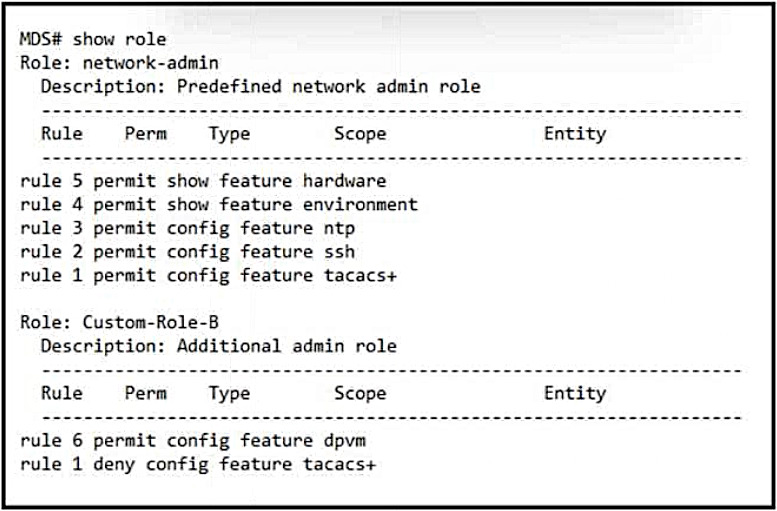
Refer to the exhibit. A Cisco MDS 9000 Series Switch is configured with RBAC. The default role applies to all users. User A is also assigned to the role Custom-Role-B. Which set of features will user A be authorized to configure? - image
  1. NTP -
  2. SSH - Correct Answer
  3. DPVM -
  4. hardware

Community Votes

B
100%

100% of anonymous learners picked answer B. Votes are pick records left by other test-takers — they are not the verified answer.

Community Insight

MDS RBAC conflict resolution: same rule type applies both; different rule type means the default role's rule applies and overrides the configured role. So a user's effective permission for a contested feature is determined by the default role, not the custom role.

In MDS RBAC, when the default role and a user's configured role have different rule types for the same feature, the default role's rule overrides the configured role. User A (default + Custom-Role-B) is therefore authorized only for features where the default role permits — here, SSH.

Assuming the custom role adds its permissions on top of the default. It does only when rule types match; when they differ, the default wins. Hence User A gets only what the default role grants (SSH), not NTP/DPVM/hardware from Custom-Role-B.

Community Discussion (7 comments)

WhiteBear87 👍 1 Selected: B
Look at the rule type. same rule type >> apply both different rule type >> default rule apply
CoAsT_x 👍 2 Selected: B
Was confusing to me too, until i found their exact example, so they are insinuating the user has this network-admin role, so, yes, B for sure. https://www.cisco.com/c/en/us/td/docs/switches/datacenter/mds9000/sw/8_x/config/security/cisco_mds9000_security_config_guide_8x/configuring_users_and_common_roles.html Different rule type — If the default role and the configured role for a specific user have different rule types for a particular rule, then the default role will override the conflicting rule statement of the configured role.If the default role, say A, has the following rules: rule 5 permit show feature environment rule 4 permit show feature hardware rule 3 permit config feature ssh -> yes rule 2 permit config feature ntp -> yes rule 1 permit config feature tacacs+ -> yes <reached comment limit>
elper 👍 1 Selected: B
Agree with B.
wickkkkkkkkkkkkkkkkkk 👍 1
this one chooes DDDDD
JobProcess 👍 1 Selected: B
answer is B:
crooks_1988 👍 3
Bit confusing but agree answer is B: Different rule type—If the default role and the configured role for a specific user have different rule types for a particular rule, then the default role will override the conflicting rule statement of the configured role.
luisam 👍 3
Answer B

Comments & Corrections

No comments yet — spotted an error or have a note? Share it below.

Log in to comment, report an error, or add a note about this question.

Submitted for moderation before publishing. Keep it helpful and respectful.

Expert Analysis

Why the Answer Is Correct

Per MDS RBAC, "If the default role and the configured role for a specific user have different rule types for a particular rule, then the default role will override the conflicting rule statement of the configured role." The exhibit shows SSH permitted by the default role and denied/undefined by Custom-Role-B (different rule types), so the default's permit for SSH wins. NTP/DPVM/hardware are governed by the custom role but overridden by the default's differing rule, leaving only SSH authorized.

Why the Other Options Are Wrong

A (NTP), C (DPVM), and D (hardware) are granted by Custom-Role-B but are overridden by the default role's conflicting rule type, so User A is not authorized for them. Only SSH, where the default role permits and the rule types differ, remains authorized.

Community Comment Notes

Community: "Different rule type — If the default role and the configured role for a specific user have different rule types... the default role will override the conflicting rule statement of the configured role"; "B for sure." Votes B 100.

Official Reference

Related Analysis

← Back to 350-601 Study Guide