OSPF Prefix Suppression Configuration for LSA Reduction

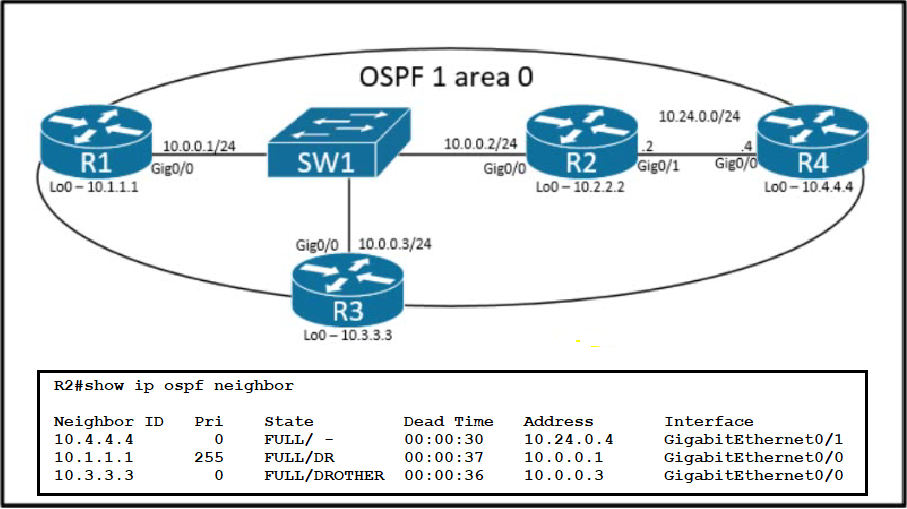
Refer to the exhibit. exhibit An engineer must reduce the number of Type 1 and Type 2 LSAs that are advertised to R4 within OSPF area 0. Which configuration must be applied?
  1. R1# conf t Router(config)# router ospf 1 Router(config-router)# prefix-suppression Correct Answer
  2. R4# conf t Router(config)# router ospf 1 Router(config-router)# summary-address 10.0.0.0 255.255.255.0
  3. R2# conf t Router(config)# interface Gig0/0 Router(config-router)# ip ospf prefix-suppression
  4. R2# conf t Router(config)# int Gig0/0 Router(config-if)# ip summary-address 10.0.0.0 255.255.255.0
Answer Correct answer: A — Apply the prefix-suppression command globally under the OSPF process on R1 to reduce Type 1 and Type 2 LSAs.

Community Insight

This question tests OSPF prefix suppression and CLI syntax validation, where the per-interface option is invalid due to an incorrect configuration prompt.

This page resolves a 350-401 ENCOR exam question about configuring OSPF prefix suppression to reduce Type 1 and Type 2 LSAs. It establishes that applying the command globally on the Designated Router (R1) is the correct approach, as the per-interface option contains a syntax error.

Choosing the interface-level configuration (Option C) because it seems more targeted, without noticing the config-router prompt error instead of config-if.

Community Discussion (31 comments)

GNOC_SCOTIA 👍 1 Selected: A
It is A because R1 is the DR. On Broadcast network, it is the DR that generates the TYpe 2 (Network) LSA so here is the best place to apply the prefix-suppression
Rowdy_47 👍 1 Selected: C
B is wrong, no such command R20(config-if)#sum? % Unrecognized command D is wrong, option only seems to be available for RIP and EIGRP R20(config-if)#ip summary-address ? eigrp Enhanced Interior Gateway Routing Protocol (EIGRP) rip Routing Information Protocol (RIP) Prefix suppression command can be done both globally under router ospf config or on the interface directly OSPF prefix-suppression prevents the advertisement of link IP prefixes in Type-1 (Router) and Type-2 (Network) LSAs, reducing LSDB size and improving convergence. When configured globally under router ospf, it suppresses prefixes for all interfaces, while interface-level (ip ospf prefix-suppression) only suppresses that specific interface, taking precedence. Key Differences & Functionality: Because the questions sates "that are advertised to R4 within OSPF area 0" I would go with option C as it will only affect LSAs to R4 and not the whole area
studyguy42 👍 1 Selected: C
From ChatGPT: Why Option C is Correct: ip ospf prefix-suppression on interface Gig0/0 will: Prevent advertising the IP prefix of that interface into OSPF (in Type 1 LSAs). This reduces the LSA size/content, and depending on network design, may reduce unneeded Type 2 LSAs as well (e.g., if the interface connects to a stub or non-broadcast segment). This is a targeted, interface-level suppression, minimizing LSA data visible to downstream routers like R4.
studyguy42 👍 1 Selected: A
Option A (Correct): The prefix-suppression command, applied under the OSPF process on R1, enables OSPF prefix suppression. This feature prevents the advertisement of Type 1 and Type 2 LSAs for specific prefixes (e.g., loopback interfaces or transit networks) that are not necessary for routing decisions, reducing the size of the OSPF link-state database (LSDB) advertised to R4. By suppressing unnecessary prefixes, R1 advertises only the essential routing information, directly addressing the goal of reducing Type 1 and Type 2 LSAs. This is a global OSPF configuration applied at the router level, affecting all interfaces unless overridden.
zbeugene7 👍 1 Selected: A
it's A, modelled in GNS3 , verified. R4#show ip ospf neighbor Neighbor ID Pri State Dead Time Address Interface 10.2.2.2 0 FULL/ - 00:00:36 10.24.0.2 FastEthernet0/0 R4#show ip route ... 10.0.0.0/8 is variably subnetted, 5 subnets, 2 masks O 10.2.2.2/32 [110/2] via 10.24.0.2, 00:00:15, FastEthernet0/0 O 10.3.3.3/32 [110/12] via 10.24.0.2, 00:00:15, FastEthernet0/0 O 10.1.1.1/32 [110/12] via 10.24.0.2, 00:00:15, FastEthernet0/0 C 10.4.4.4/32 is directly connected, Loopback0 C 10.24.0.0/24 is directly connected, FastEthernet0/0
Steve122 👍 1 Selected: C
C is correct and neat solution.
cutetruck 👍 2
C is correct. The reasoning is simple. Firstly, you're suppressing type 1 and type 2 LSAs only for router R4. If you do it on R1, every router will receive prefix suppression from R1, not just R4. Secondly, it's supposed to be performed under interface configuration, not router configuration. This whitepaper from Cisco displays a great example of how it works https://www.cisco.com/c/en/us/support/docs/ip/open-shortest-path-first-ospf/213404-open-shortest-path-first-prefix-suppress.html
karimarien 👍 1
A Definitely . Like nikramor i simulated and c is not working. indeed R1 has a 255 priority and thus it's the DR on the left part. Cheers
Shri_Fcb10 👍 2 Selected: C
Why Option C is Preferred: Precision: Option C targets the interface directly connected to the segment where reduction is needed, minimizing unnecessary LSA advertisements to R4 without globally affecting the entire OSPF process on R1 or any other router. Control: By applying prefix suppression at the interface level, you maintain finer control over which LSAs are suppressed, avoiding potential issues that could arise from globally suppressing LSAs on all interfaces of R1. Why Not Option A: Broad Impact: Applying prefix suppression globally on R1 (Option A) impacts all connected interfaces and can lead to unintended consequences in OSPF routing within the entire area. Overreach: This broader approach might suppress important routing information that other routers in the OSPF area need, potentially leading to suboptimal routing or even routing issues.
ZarNi 👍 1 Selected: C
answer is C.
AM17212 👍 2 Selected: A
A. Because R1 is the DR, we can configure it on under the router ospf.
cwauch 👍 5 Selected: A
A is the best answer as far as the config goes. C will NOT work because if you look closely, after the int gi0/0 command, it is now in "router" config mode and it should be in "interface" config mode.
eearmani 👍 1 Selected: C
the question is for LSA 1 , 2 to router 4 i would go for C
djedeen 👍 2 Selected: A
Going with A. There are 2 approaches for prefix suppression, global mode configuration and interface mode configuration. The global config (option A) only requires the config shown, interface level suppression would need to be applied on multiple interfaces for the same effect.
alex711 👍 1 Selected: C
I testet it on gns3. It is C.
jubrilak 👍 4
The corect answer is A. Why? 1) The suppression for each transit subnet is effected by the DR for that link 2) Only advertised transit link prefixes are affected, hence the prefixes to be suppressed is only the 10.0.0.0/24 prefix, because 10.24.0.0/24 prefix is a connected prefix to R4. 3) Simply implementing the prefix suppression on R1, will suppress 10.0.0.0/24 prefix in the FIB of R4 4) If you implement ip ospf prefix suppression on R2, it won't suppress the 10.0.0.0/24 prefix on R4, because it is not the DR for that segment.
rogue_user 👍 1 Selected: C
If you apply A it will have effect in opposite direction as well
nikramor 👍 9 Selected: A
I simulated this topology and the correct answer is A. Only prefix-suppression on R1(DR) under router ospf 1 is needed. You can enable prefix suppression on links between R1-R2 and it would work like a charm. But on this question i'd choose A
ajeetnagdev 👍 3
A is correct. Type 2 – Network LSA: Network LSAs are generated by the DR. Router R1 is DR.
felix_simon 👍 1
C If A is selected, type 1 and type 3LSA announcements between R1 and R3 will be suppressed, which is not true.
massimp 👍 4 Selected: A
C should be the most correct, unless the interface is wrong (must be gi0/1). So A is the most correct.
foreignbishop 👍 1 Selected: C
R1 may be the DR in the segment but NOT the entire area. Therefore, the P2P link communication between 2 and 4 would be different regarding LSA advertisements. Therefore, I think C is correct.
ALOVEVIKS 👍 4 Selected: A
OSPF prefix-suppression is a useful feature in order to reduce the number of Link State Advertisement (LSA) that are flooded within an area. In an OSPF area which has multiple transit links between hosts and actual communication is between the hosts. There is no need to advertise the transit link LSAs to all the routers. You can only advertise the LSAs related to end hosts. By default, OSPF advertises all the LSAs that include the transit link LSAs. OSPF prefix-suppression feature helps to overcome this behavior and reduces the number of Type 1(router) and Type 2(network) LSAs advertised. This feature can be enabled globally on a router or on per interfaces basis. OSPF prefix-suppression helps in faster Shortest Path First (SPF) calculation due to less number of prefixes in the database (DB). OSPF Type 3, Type 4, Type 5, or Type 7 LSAs are not suppressed. https://www.cisco.com/c/en/us/support/docs/ip/open-shortest-path-first-ospf/213404-open-shortest-path-first-prefix-suppress.html
HungarianDish_111 👍 3 Selected: C
I would say C, but on the correct interface. R2 gig0/1. https://community.cisco.com/t5/networking-knowledge-base/ospf-prefix-suppression/ta-p/3293724
HungarianDish_111 👍 2
I think that none of the listed answers are correct. I would apply it on R2 gig0/1 (facing R4). NOT on R2 gig0/0. There is a point-to-point link btw R2-R4. It means that no LSA type 2 is generated! Prefix-supression reduces type1 and type 3 on point-to-point, and it is recommended to apply also on point-to-point.
jackr76 👍 1 Selected: C
See snarkymark
Symirnian 👍 1
R1 is seen as the DR for OSPF. So prefix suppress command in DR is useful for all broadcasts in the area? If I am wrong please correct.
bendarkel 👍 2
In the case of routers R1, R2, R3, it should be configured on each OSPF interface attached to that Ethernet segment. Simply put, you cannot just configure OSPF prefix-suppression on one side.
Jeff555566 👍 2
It looks like prefix suppression needs to be put on all of the routers, not just one of them.
Sammy3637 👍 3 Selected: A
Prefix suppression should do the trick https://networklessons.com/cisco/ccie-routing-switching-written/ospf-prefix-suppression
snarkymark 👍 12
I would think prefix suppression would be better if placed on R2 on the interface facing R4. Being applied globally on R1 won't suppress routes from other routers to R4. Like to see what others think. https://itskillbuilding.com/networking/network/ospf/ospf-prefix-suppression/

Comments & Corrections

No comments yet — spotted an error or have a note? Share it below.

Log in to comment, report an error, or add a note about this question.

Submitted for moderation before publishing. Keep it helpful and respectful.

Expert Analysis

Why the Answer Is Correct

Option A correctly uses the global prefix-suppression command under the OSPF process on R1. Because R1 is the Designated Router (DR) for the transit network, it generates the Type 2 Network LSA; applying prefix suppression on the DR effectively removes the transit link prefixes from both Type 1 and Type 2 LSAs, reducing the LSA size advertised to R4. The configuration syntax in Option A is also completely valid.

Why the Other Options Are Wrong

Options B and D use the summary-address command, which creates summary routes but does not suppress Type 1 and Type 2 LSA prefixes. Option C appears to apply interface-level prefix suppression, but contains a fatal syntax error: after entering interface Gig0/0, the prompt incorrectly shows Router(config-router)# instead of the required Router(config-if)#, making the configuration invalid.

Community Comment Notes

Several users noted that Option C is invalid due to the incorrect prompt, as cwauch pointed out: "after the int gi0/0 command, it is now in 'router' config mode and it should be in 'interface' config mode." Others validated Option A through simulation, with nikramor stating, "Only prefix-suppression on R1(DR) under router ospf 1 is needed." Additionally, jubrilak explained that "suppression for each transit subnet is effected by the DR for that link," confirming R1 is the correct target.

Official Reference

Exam Strategy

Pay close attention to CLI prompts in configuration snippets, as Cisco exams often use incorrect prompts to make an option invalid. Also, remember that OSPF prefix suppression on the DR is what effectively suppresses Type 2 LSAs for a broadcast segment.

Related Analysis

Practice All 350-401 Questions

Access 218 questions with complete answers and detailed explanations.

View Full 350-401 Practice Test →

← Back to 350-401 Study Guide