What Is the Purpose of the ntp master Command in Cisco IOS?
Refer to the exhibit. What is the purpose of the configuration? - 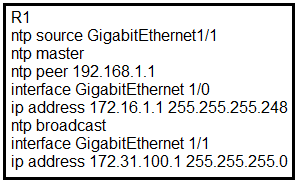
Community Votes
100% of anonymous learners picked answer D. Votes are pick records left by other test-takers — they are not the verified answer.
Community Insight
The exam tests your ability to identify the function of 'ntp master,' and the common trap is confusing it with 'ntp source' or 'ntp broadcast' which serve entirely different NTP roles.
The 'ntp master' command configures a Cisco router to function as an authoritative NTP server, allowing it to synchronize time for other devices even without an external time source. Community consensus confirms this is a straightforward command-recognition question on the 350-401 ENCOR exam.
Option A is frequently chosen by mistake because candidates confuse 'ntp master' with NTP client mode, which is actually configured using the 'ntp server' command.
Community Discussion (3 comments)
Comments & Corrections
No comments yet — spotted an error or have a note? Share it below.
Expert Analysis
Why the Answer Is Correct
The commandntp master explicitly configures the router to act as an authoritative NTP server, meaning it will advertise its own clock as a valid time source to other NTP clients. Even if the router is not synchronized to an upstream server, it will still serve time to downstream devices. This is confirmed by Cisco documentation and unanimously agreed upon by the community (Comments [1], [2], [3]).Why the Other Options Are Wrong
Option A is incorrect because NTP client mode is configured with thentp server <ip-address> command, not ntp master. Option B is wrong because setting the source interface for NTP packets requires the ntp source <interface> command. Option C is incorrect because receiving NTP broadcasts is enabled with the ntp broadcast client command on an interface, not ntp master in global configuration.Community Comment Notes
Comment [1] provides an excellent breakdown of all four options, clearly mapping each to its correct command syntax. Comment [2] links directly to the official Cisco configuration guide for NTP master, reinforcing the authoritative server role. Comment [3] succinctly confirms thatntp master makes the router an authoritative NTP server, aligning with the correct answer D. Official Reference
Exam Strategy
When you see NTP commands on the exam, memorize the distinct roles: 'ntp server' for client mode, 'ntp master' for authoritative server, and 'ntp source' for packet sourcing. Eliminate options by matching the command keyword to its specific function rather than guessing based on context clues.
Related Analysis
Practice All 350-401 Questions
Access 218 questions with complete answers and detailed explanations.
View Full 350-401 Practice Test →