Why Does OSPF Fail to Establish Adjacency Between R1 and R2?
Refer to the exhibit. Why does OSPF fail to establish an adjacency between R1 and R2? - 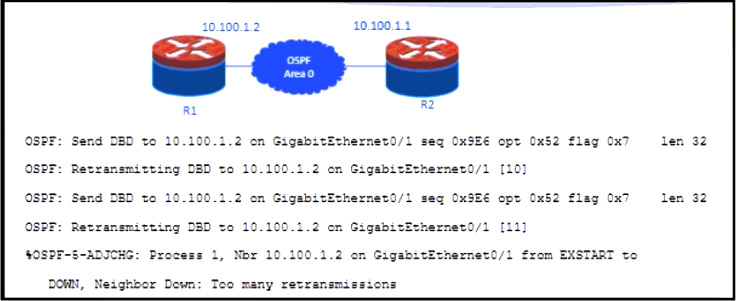
Community Votes
100% of anonymous learners picked answer B. Votes are pick records left by other test-takers — they are not the verified answer.
Community Insight
This question tests your understanding of OSPF's database description (DBD) exchange phase, where a mismatch in interface MTU prevents adjacency from progressing beyond EXSTART state, a common trap for confusing with timer or area mismatches.
OSPF adjacency can fail due to interface MTU mismatch, leaving neighbors stuck in EXSTART state. Community consensus confirms option B as the correct answer for this exhibit-based question.
Choosing timers mismatch (option C) is a common wrong answer because OSPF hello/dead timer mismatches also prevent adjacency, but the exhibit's retransmission and DBD packet size indicators point to MTU mismatch, not timer issues.
Community Discussion (3 comments)
Comments & Corrections
No comments yet — spotted an error or have a note? Share it below.
Expert Analysis
Why the Answer Is Correct
OSPF neighbors must have matching MTU values on the interface where they are adjacent. During the DBD exchange, the MTU is included in the DBD packet. If the receiving router has a smaller MTU than the advertised one, it will reject the DBD packet and leave the neighbor in EXSTART state, causing retransmissions and no adjacency. The exhibit shows 'retransmissions' and the debug output confirms 'has smaller interface MTU', directly pointing to option B, interface MTU mismatch.
Why the Other Options Are Wrong
Authentication mismatch (A) would cause OSPF packets to be dropped or ignored, typically not allowing the state to even reach EXSTART. Timers mismatch (C) would prevent hello exchange and keep neighbors stuck in DOWN or INIT, not EXSTART. Area mismatch (D) would cause OSPF to ignore hello packets because the area ID does not match, again preventing neighbor state progression. The debug output clearly shows EXSTART and DBD-related errors, which are specific to MTU mismatches.
Community Comment Notes
One comment highlights 'MTU is the maximum packet size' and mentions 'retransmissions', which is a key clue in the exhibit. Another commenter recreated the lab and showed the exact log: 'Nbr 1.1.1.1 has smaller interface MTU', confirming MTU mismatch. A third comment mentions 'EXSTART state is the keyword', which is a strong diagnostic indicator for MTU or router ID mismatch—but since the exhibit focuses on MTU, B is correct.
Official Reference
Exam Strategy
When OSPF adjacency is stuck in EXSTART, always check interface MTU mismatch first—a common hidden trap. Use 'debug ip ospf adjacency' or 'show ip ospf interface' to verify MTU and quickly eliminate the other options by focusing on the state progression. Remember that timer, area, and authentication issues prevent adjacency before EXSTART, whereas MTU mismatch specifically blocks DBD exchange.
Related Analysis
Practice All 350-401 Questions
Access 218 questions with complete answers and detailed explanations.
View Full 350-401 Practice Test →