How to Automatically Enable Privileged EXEC Mode via SSH?
Refer to the exhibit. Which action automatically enables privilege exec mode when logging in via SSH? - 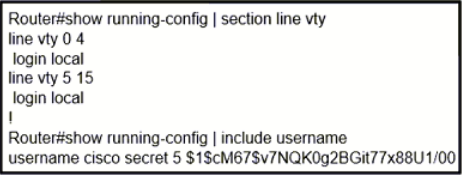
Community Votes
56% of anonymous learners picked answer D. Votes are pick records left by other test-takers — they are not the verified answer.
Community Insight
It tests the distinction between line-level defaults and user-specific authorization, highlighting that login local requires privilege assignment at the user definition level, not the VTY line level.
This question tests how Cisco IOS assigns privilege levels during remote SSH access. The community consensus supports configuring the privilege level directly on the local username database when login local is enabled.
Candidates often choose option C (line vty privilege level 15) assuming it globally overrides all sessions, failing to account for the login local directive which prioritizes the local username database settings.
Community Discussion (16 comments)
Comments & Corrections
No comments yet — spotted an error or have a note? Share it below.
Expert Analysis
Understanding the Configuration Context
Based on the exhibit (which typically shows line vty 0 4 followed by login local and a username cisco entry), the question focuses on how Cisco IOS handles authorization when local authentication is enforced. The login local command redirects VTY sessions to validate credentials against the router's local username database rather than prompting for a simple line password.Why Option D is Correct
By default, all authenticated users enter User EXEC mode (Privilege Level 1). To bypass the manual enable command and land directly in Privileged EXEC mode (Level 15), you must explicitly assign that level to the user account. The command username cisco privilege 15 secret <password> achieves this. Because login local is active, the device checks the local database for both authentication and authorization, making the user-specific privilege setting the authoritative source for session initialization. As noted by community members testing in EVE-NG, this configuration reliably grants immediate privileged access.Why Option C is a Common Trap
Many candidates select Option C (line vty 0 4 → privilege level 15) assuming it acts as a global override for all remote sessions. While line vty privilege level does change the default for unauthenticated or non-local-authenticated sessions, it does not override user-specific authorization when login local is configured. In Cisco IOS, user-level privilege assignments take precedence over line-level defaults for authenticated sessions. Therefore, C would only work if the line used simple password authentication (login without local), which contradicts the exhibit's implied configuration.Eliminating Other Options
- Option A only sets a line password; it does not influence privilege levels or trigger automatic elevation.
- Option B suggests matching secrets, which is a severe security anti-pattern and has no functional impact on privilege escalation mechanics.
Official Reference
- https://www.cisco.com/c/en/us/td/docs/switches/lan/catalyst2960l/software/15-2_5_e/config-guide/b_1525e_consolidated_2960l_cg/b_1525e_consolidated_2960l_cg_chapter_0100001.pdf
- https://learningnetwork.cisco.com/s/question/0D53i00000KstA2CAJ/privilege-level-when-username-command-is-configured
- https://www.cisco.com/c/en/us/td/docs/ios-xml/ios/user/index.html
Exam Strategy
When troubleshooting or designing remote access policies, always check the authentication method first. If login local or AAA is specified, prioritize user-database or server-side authorization settings over line-level configurations. Exams frequently test this hierarchy to ensure you understand that user-specific commands override line defaults.
Related Analysis
Practice All 350-401 Questions
Access 218 questions with complete answers and detailed explanations.
View Full 350-401 Practice Test →