How Do You Configure the TrustSec PAC Key on a Catalyst Switch?
DRAG DROP
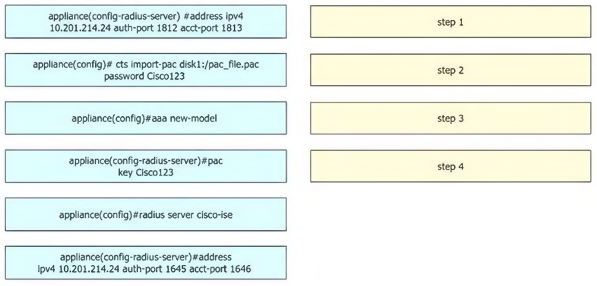
A security engineer configures a Cisco Catalyst switch to use Cisco TrustSec. The engineer must define the PAC key to authenticate the switch to Cisco ISE. Drag and drop the commands from the left into sequence on the right. Not all options are used.
Community Insight
The item tests that on IOS/IOS-XE the PAC shared key is configured as a sub-command of the named RADIUS server object, and the trap is reaching for the ASA-only 'cts import-pac' command or the retired RADIUS ports 1645/1646.
This 300-715 drag-and-drop item asks you to sequence the Cisco IOS commands that define a Protected Access Credential (PAC) key so a Catalyst switch can authenticate to Cisco ISE for Cisco TrustSec. The page establishes the correct four-step order — aaa new-model, radius server cisco-ise, address ipv4 ... auth-port 1812 acct-port 1813, then pac key Cisco123.
The most common wrong approach is starting the sequence with 'cts import-pac' (an ASA command that does not exist on Catalyst IOS) or using legacy ports 1645/1646; a secondary error is placing 'pac key Cisco123' before the 'radius server cisco-ise' object and its 'address ipv4' statement exist.
Community Discussion (5 comments)
Comments & Corrections
No comments yet — spotted an error or have a note? Share it below.
Expert Analysis
Why the Answer Is Correct
The sequence begins with aaa new-model, which globally enables the AAA subsystem and is a prerequisite for any named RADIUS server object on IOS/IOS-XE. The engineer then creates the server object with radius server cisco-ise, entering the RADIUS server configuration submode where the ISE Policy Service Node is defined. Inside that submode, address ipv4 10.201.214.24 auth-port 1812 acct-port 1813 binds the server object to the ISE node using the IETF-standard RADIUS authentication and accounting ports, which Cisco ISE listens on by default. Finally, pac key Cisco123 configures the Protected Access Credential shared key inside the same server block; this is the key the switch uses to authenticate itself to ISE during PAC provisioning for TrustSec/SXP (environment-data and device-authorization exchanges). Because the PAC key lives under the named RADIUS server, it cannot be configured before the server object and its address statement are in place, which fixes the drag order unambiguously.Why Other Candidate Answers Are Wrong
cts import-pac is the highest-value distractor: it is Cisco ASA syntax, not Catalyst IOS/IOS-XE, so a switch rejects it outright. Commands that reference ports 1645/1646 are wrong because those are the legacy RADIUS ports that predate RFC 2865/2866; current ISE deployments and the Catalyst TrustSec configuration guide use 1812/1813. Ordering variants that place pac key Cisco123 first, or that put address ipv4... after the PAC key, fail because the key is scoped to the RADIUS server object and the address defines that object's endpoint. Any distractor taken from unrelated AAA configuration — dot1x, MAB, or CoA-style statements — does nothing toward PAC provisioning and is therefore unused.Community Comment Notes
Cachaman flagged the exact trap in the option set, stating that "Cts import-pac is not a valid command and 1645 and 1646 are the old RADIUS ports" and listing the corrected order ending in "pac key Cisco123". Rododendron2 reinforced the platform distinction with the remark that "Cts import-pac is for Cisco ASA, not IOS", which matches Cisco's Catalyst TrustSec documentation. AhmedY and Cname both arrived at the same four-line sequence and pointed to Cisco's IOS TrustSec configuration guide as the authority, with Cname adding the explanation that the address statement "Defines the ISE node's IP address and standard IETF RADIUS ports (1812/1813)" while the PAC key is set inside that RADIUS server stanza. The consistent community consensus therefore lines up with the vendor documentation rather than with the ASA-style distractors.Official Reference
Exam Strategy
When a drag-and-drop lists IOS configuration commands, first separate platform-specific distractors (ASA-style commands such as 'cts import-pac') from real IOS/IOS-XE syntax, then order from the global enabler down to the most specific parameter. Remember that a sub-command can never precede the mode that contains it, so 'pac key' must come after 'radius server cisco-ise' and its 'address ipv4' line.
Frequently Asked Questions
Where is the TrustSec PAC key configured on a Catalyst IOS switch?
Inside the named RADIUS server stanza — 'radius server cisco-ise' followed by 'pac key Cisco123' — not with the ASA command 'cts import-pac', which IOS does not support.
Why are auth-port 1812 and acct-port 1813 used instead of 1645 and 1646?
1812/1813 are the IETF-standard RADIUS authentication and accounting ports defined by RFC 2865/2866, while 1645/1646 are the legacy pre-RFC values that Cisco ISE and current TrustSec guides no longer use.