Which Tunnel Endpoint Type Is Shown in the ACI Lo0 Interface Output?
Short answer
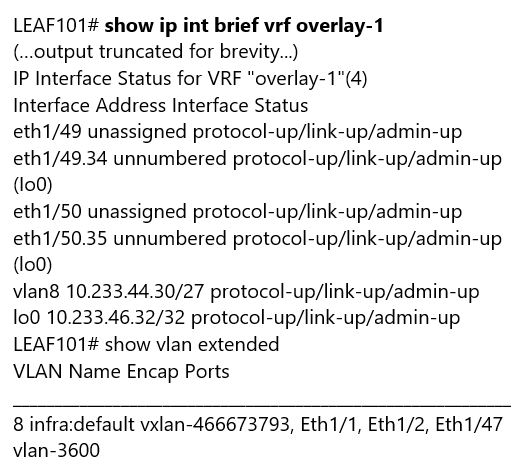
A ACI interface Lo0 is the physical tunnel endpoint (PTEP) that sources VXLAN encapsulation within the fabric.
Question
Key Takeaways
The question tests the ACI tunnel endpoint taxonomy — Lo0 is the PTEP — and the trap is the plausible-sounding 'fabric' label, which is not a Cisco TEP type.
In Cisco ACI, interface Lo0 on every leaf and spine switch sources all intra-fabric VXLAN encapsulation and is officially named the physical tunnel endpoint (PTEP). This page establishes why the Lo0 output identifies a PTEP, making 'physical' the correct choice over 'fabric', 'dynamic', or 'headend replication'.
Common mistake: The most common wrong pick is 'fabric' because Lo0 operates inside the ACI fabric, but Cisco documents Lo0 as the physical tunnel endpoint (PTEP), so option B is an informal label rather than a real TEP classification.
Expert Analysis
Why the Answer Is Correct
In the ACI fabric, every leaf switch sources VXLAN-encapsulated intra-fabric traffic from loopback interface Lo0. Cisco's ACI documentation explicitly names this interface the physical tunnel endpoint (PTEP): it is the VXLAN source address for unicast tunnels between leafs and spines, and it doubles as the LISP RLOC each leaf registers for endpoint reachability. The output shown for interface Lo0 therefore depicts the switch's PTEP, which maps directly to option A, 'physical'.
Why the Other Options Are Wrong
'Fabric' is descriptive but not a TEP type Cisco assigns to Lo0 — the documented categories are PTEP (physical switches), dTEP (Multi-Pod), and vTEP (virtual/AVS), so option B is a plausible but unsupported label. 'Dynamic' is not a tunnel endpoint classification anywhere in ACI VXLAN terminology. 'Headend replication' describes a BUM-traffic mode in which the ingress leaf replicates broadcast, unknown-unicast, and multicast frames over unicast VXLAN tunnels; it characterizes a forwarding method, not the identity of the endpoint on Lo0.
Community Comment Notes
The community leans clearly toward A — as ed27 put it, "Loopback 0 is physical tunnel endpoint", and Ceara agrees that "lo0 is the PTEP (physical)". The dissent comes from designated, who reasons that Lo0 is the VTEP and therefore 'fabric', but this conflates Lo0's generic VTEP role with the specific TEP classification the question asks for; Cisco's own documentation calls Lo0 the PTEP. Marinheiro's bare vote for B offers no technical justification, so both the majority consensus and Cisco terminology support A.
Exam Strategy
Memorize the ACI TEP taxonomy: Lo0 on every switch is the PTEP, dTEP appears in Multi-Pod designs, and vTEP refers to AVS. When a Lo0 output appears in a tunnel-endpoint question, Cisco's own term — physical — is the safe pick over informal labels like 'fabric'.
Community Votes
67% of anonymous learners picked answer A. Votes are pick records left by other test-takers — they are not the verified answer.
Discussion 4 contributions
Compiled from public community threads and reader submissions, lightly edited for clarity. Handles and vote tallies are shown as recorded, and comments reflect the views of individual contributors.
From public community threads 4
-
ed27 👍 6 Answered ALoopback 0 is physical tunnel endpoint
-
designated 👍 2 Answered BThe lo0 interface with its assigned IP address acts as the VXLAN Tunnel Endpoint (VTEP), enabling VXLAN encapsulation within the ACI fabric. Thus, the answer is B. Fabric. The loopback interface (lo0) is the VTEP, not the PTEP. The PTEP refers to the physical interfaces (e.g., eth1/49, eth1/50) that carry VXLAN traffic over the fabric underlay. • PTEP: The physical interface on which VXLAN traffic flows. • VTEP (lo0): The logical representation of the VXLAN endpoint, using the loopback interface for encapsulation/decapsulation.
-
Ceara 👍 2 Answered Alo0 is the PTEP (physical).
-
Marinheiro 👍 2 Answered BIt is fabric
Reader comments & corrections
No reader corrections yet — spotted an error or have a note? Share it below.