How to Add a Second L3Out Link to Core-2 for BL-1002 Connectivity?
Refer to the exhibit. A tenant is configured with a single L3Out and a single-homed link to the core router called Core-1. An engineer must add a second link to the L3Out that connects to the Core-2 router. Which action allows traffic from Core-2 to BL-1002 to have the same connectivity as the traffic from Core-1 to BL-1001? - 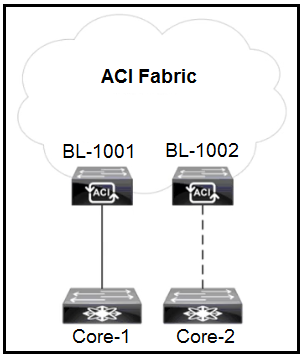
Community Votes
100% of anonymous learners picked answer C. Votes are pick records left by other test-takers — they are not the verified answer.
Community Insight
Tests ACI L3Out path configuration: a second link is added as a new path in the logical interface profile, not as a new OSPF profile, interface, or subnet.
In Cisco ACI, extending an L3Out to a second core router requires adding a second path under the existing logical interface profile. This page confirms the correct action to give Core-2 the same connectivity to BL-1002 as Core-1 has to BL-1001.
Choosing to add a second OSPF interface profile (A) — OSPF parameters live on the logical interface profile, and a new path inherits them; adding another profile is not the required step.
Community Discussion (3 comments)
Comments & Corrections
No comments yet — spotted an error or have a note? Share it below.
Expert Analysis
Why the Answer Is Correct
C. In Cisco ACI, an L3Out's connectivity to external routers is defined through logical node profiles, which contain logical interface profiles, and each logical interface profile holds one or more paths. A path specifies the node, interface, IP address, and VLAN for a single-homed link. To add a second physical link to Core-2, you create a second path under the existing logical interface profile. Because the logical interface profile already contains the OSPF interface profile and other routing settings, the new path automatically inherits the same OSPF adjacency parameters, giving Core-2 the same connectivity to BL-1002 as Core-1 provides to BL-1001. No new L3Out, external EPG, or OSPF profile is needed.Why the Other Options Are Wrong
A: Adding a second OSPF interface profile is unnecessary and, in ACI, an OSPF interface profile is a property of the logical interface profile; a second path under the same logical interface profile uses the existing OSPF profile. B: "External domain" is not an ACI construct for adding L3Out links; interfaces are defined via paths, not by adding an interface to an external domain. D: Adding a second subnet to the external EPG changes the advertised prefix space, not the physical link connectivity to Core-2; it does not create the new path required for the second router.Community Comment Notes
All voters chose C. As prospio971 noted, "you must configure a new path in the logical interface profile associated with the L3Out" to enable traffic from both Core-1 and Core-2. udo2020 agreed that "We can add a second path under the logical interface profile," and Huberttheman simply stated "I think c is correct." The community consensus is unanimous and aligns with the ACI configuration model.Exam Strategy
In ACI L3Out questions, remember that physical links are represented as paths under a logical interface profile. If the question asks to add a link while keeping existing routing, choose the option that adds a path, not a new profile or subnet.
Frequently Asked Questions
Why is adding a second OSPF interface profile not the right action?
The OSPF interface profile already exists on the logical interface profile; a new path automatically uses it, so adding another profile is unnecessary.
What does adding a second path under the logical interface profile accomplish?
It creates the new link to Core-2 with its own IP and VLAN, inheriting the existing OSPF and routing settings for identical connectivity.