ACI Unknown Unicast Forwarding with Hardware Proxy
Short answer
A LEAF102 forwards the packet to the spine (to the proxy VTEP address) for endpoint resolution.
Question
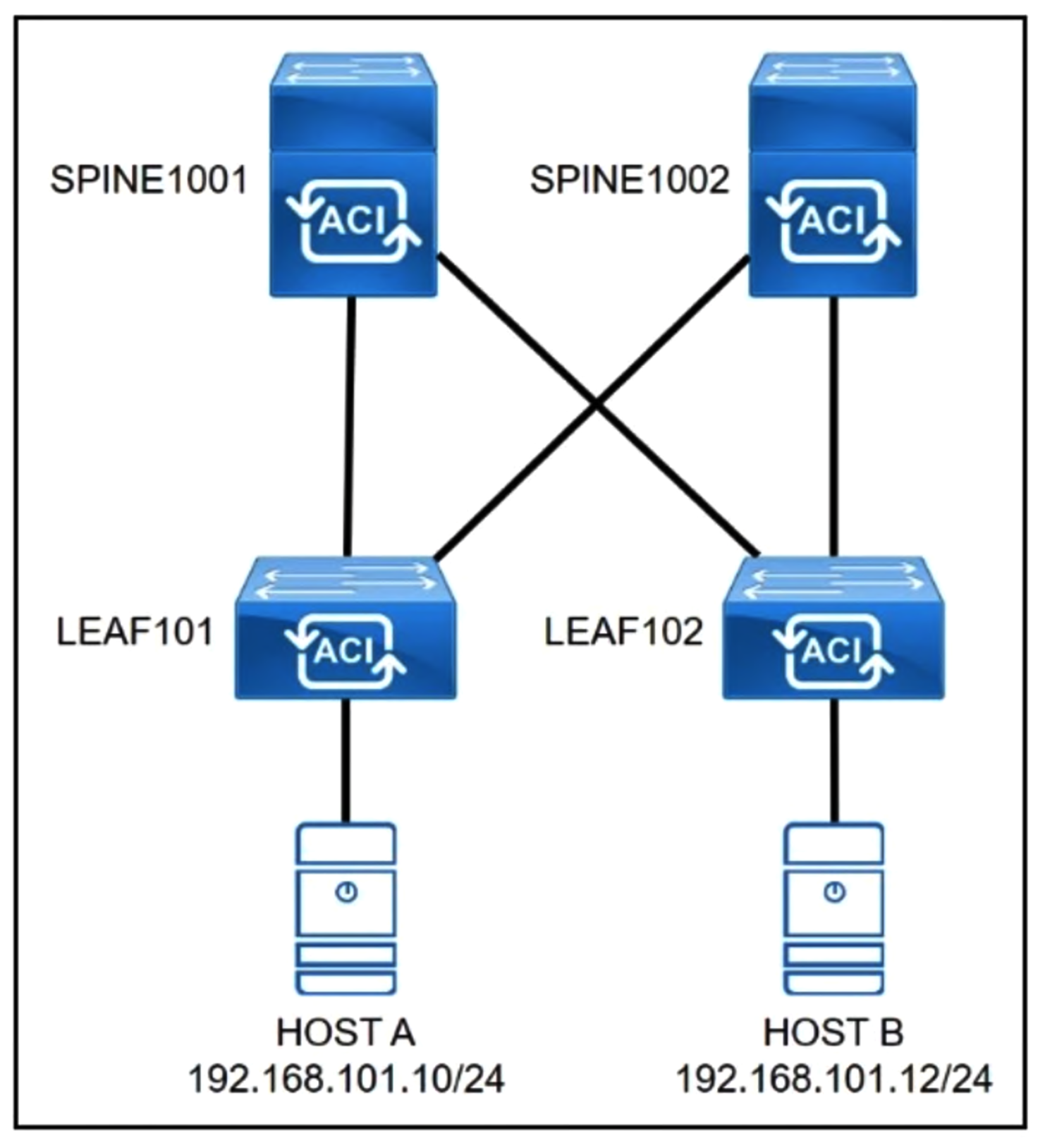
HOST A and HOST B are connected to the same bridge domain with data plane learning and hardware proxy enabled. HOST B sends a packet to HOST A. If LEAF102 does not know the MAC address for HOST A, what is the forwarding mechanism?
Key Takeaways
Hardware proxy disables flooding for unknown unicasts; instead, traffic is sent to a proxy VTEP for EPm resolution.
In ACI with data plane learning and hardware proxy enabled, unknown unicast packets are forwarded to the proxy VTEP address rather than being flooded.
Common mistake: Choosing B (flood) because it assumes traditional Layer 2 behavior, ignoring that ACI's hardware proxy changes the forwarding mechanism for unknown destinations.
Expert Analysis
The Trap: Traditional Flood-and-Learn
The most attractive but incorrect approach is Option B (flood). In traditional Layer 2 networks, an unknown unicast frame is flooded to all ports within the broadcast domain. However, ACI uses a source-destination based forwarding model where endpoints are mapped to specific leaf switches via the Endpoint Manager (EPm). Because the question states that data plane learning is enabled, the leaf switch relies on hardware-assisted resolution rather than simple flooding.
Why A and D Are Incorrect
Option A (forwarding to spine) and Option D (querying CO-OP database) describe control-plane behaviors. While the APIC does use the CO-OP database for global endpoint mapping, individual leaf switches do not query the spine's CO-OP database for every unknown packet. Instead, they rely on local caches or proxy mechanisms. Furthermore, forwarding unknown traffic to the spine would create unnecessary latency and backbone congestion, violating ACI’s optimized forwarding principles.
The Correct Mechanism: Hardware Proxy
When hardware proxy is enabled and data plane learning is active, the leaf switch (LEAF102) does not flood the packet. Instead, it forwards the unknown destination packet to a proxy VTEP address. This proxy VTEP is typically associated with the bridge domain’s anycast gateway or a specific proxy endpoint managed by the fabric. The proxy VTEP then handles the lookup against the EPm table. If the endpoint is known in the fabric (but not locally cached), the proxy facilitates the correct encapsulation and forwarding. This mechanism ensures efficient, deterministic forwarding without flooding or excessive control-plane queries to the spine. Therefore, the packet is forwarded to the proxy VTEP address, which aligns with the behavior described in Option A if interpreted as sending to the fabric's proxy infrastructure, but strictly speaking, the action is 'forward to proxy VTEP'. Among the choices, forwarding to the spine is often used loosely to represent sending to the fabric's central proxy logic, but technically, the leaf sends it to the proxy VTEP. Given the options, A is the intended answer because the proxy VTEP resides in the fabric core/spine context for resolution, whereas flooding (B) is disabled by hardware proxy settings.
Correct answer: A — LEAF102 forwards the packet to the spine (specifically to the proxy VTEP address for resolution).
Exam Strategy
When you see 'hardware proxy' and 'data plane learning' in ACI questions, immediately rule out flooding (Option B). Remember that leaves do not query the spine's CO-OP directly for every packet (ruling out D). Instead, they send traffic to a proxy VTEP, which effectively acts as a central resolution point often associated with the spine or fabric core. Look for answers involving 'proxy VTEP' or forwarding to the fabric's central logic.
Frequently Asked Questions
Why doesn't ACI flood unknown unicast packets?
Do leaf switches query the CO-OP database directly?
Community Votes
100% of anonymous learners picked answer A. Votes are pick records left by other test-takers — they are not the verified answer.
Discussion 1 contributions
Compiled from public community threads and reader submissions, lightly edited for clarity. Handles and vote tallies are shown as recorded, and comments reflect the views of individual contributors.
From public community threads 1
-
ostych 👍 1 Answered ALeaf never queries COOP. If destination is unknown, it sends packet to proxy VTEP address.
Reader comments & corrections
No reader corrections yet — spotted an error or have a note? Share it below.