ACI OSPF Default Route Leak Policy Configuration
Short answer
B Set Scope as Context, Criteria as Leak Default Route in Addition, and Always as Yes to properly advertise the default route with other OSPF routes in Area 0.
Question
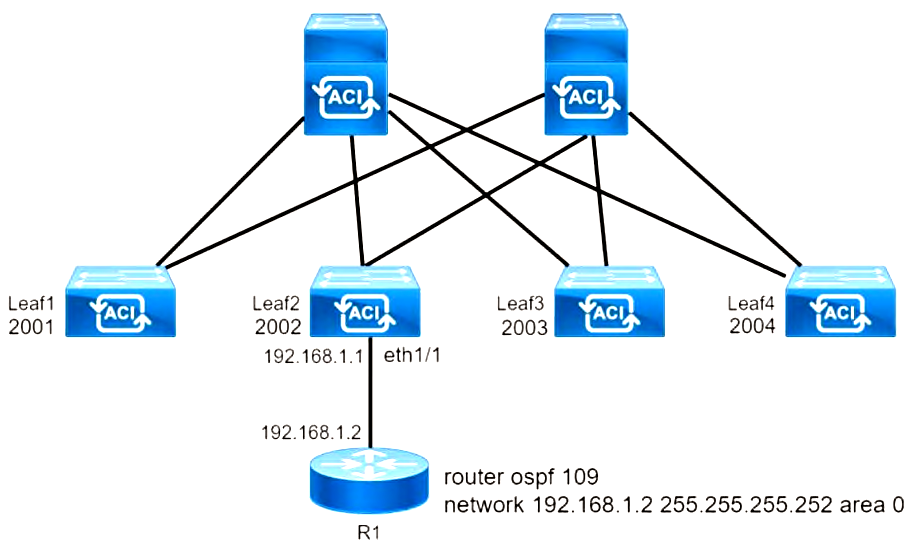
Refer to the exhibit. Cisco ACI fabric establishes OSPF adjacency with R1. The fabric must generate a default route to advertise along with all other OSPF routes to R1. Which set of actions achieves these objectives?
Key Takeaways
The main trap is confusing the 'Context' and 'Outside' scopes; Context is used for standard OSPF areas (Type-5 LSAs) while Outside is reserved for NSSA areas (Type-7 LSAs).
Learn how to configure Cisco ACI L3Out to advertise a default route alongside other OSPF routes using the correct Default Route Leak Policy settings for standard OSPF areas.
Common mistake: Choosing Option A (Outside scope) is a common mistake when users assume any L3Out configuration works similarly, but Outside scope fails in standard Area 0 environments by attempting to use NSSA-specific Type-7 LSAs.
Expert Analysis
The correct answer is B. To advertise a default route alongside other OSPF routes to an external router (R1), the ACI L3Out must use a Default Route Leak Policy. The critical decision lies in selecting the correct Scope based on the OSPF area type of the L3Out interface.
The comment correctly identifies that since the OSPF area is Area 0 (standard OSPF), the Context scope must be used. In ACI, the Context scope generates a Type-5 External LSA, which is compatible with standard OSPF areas. This allows the default route to be advertised into the VRF context and subsequently propagated to R1.
Option A is incorrect because it uses the Outside scope. The Outside scope generates a Type-7 NSSA External LSA and is specifically intended for OSPF NSSA areas. Using this in a standard Area 0 would result in compatibility issues or failure to establish the desired routing behavior.
Options C and D are incorrect because they set Criteria to Leak Default Route Only. The question explicitly states that the fabric must advertise the default route "along with all other OSPF routes." Setting the criteria to "Only" would suppress the advertisement of specific prefixes, violating the requirement. Therefore, Leak Default Route in Addition is required.
In summary, for standard OSPF areas, use Context scope with "In Addition" criteria to leak the default route while preserving other routes.
Exam Strategy
When configuring OSPF integration in ACI, always verify the OSPF area type of the L3Out before selecting the Default Route Leak Policy scope. If the area is a standard OSPF area (not NSSA or Stub), you must select 'Context' scope to generate Type-5 LSAs. If the area is an NSSA, select 'Outside' scope for Type-7 LSAs. Additionally, carefully read whether the requirement is to replace existing routes ('Only') or supplement them ('In Addition').
Frequently Asked Questions
What is the difference between Context and Outside scope in ACI Default Route Leak Policy?
Why can't I use Outside scope for OSPF Area 0?
Community Votes
100% of anonymous learners picked answer B. Votes are pick records left by other test-takers — they are not the verified answer.
Discussion 1 contributions
Compiled from public community threads and reader submissions, lightly edited for clarity. Handles and vote tallies are shown as recorded, and comments reflect the views of individual contributors.
From public community threads 1
-
ostych 👍 1 Answered BSince area is 0, Context has to be used. Context scope advertises the default as a Type-5 external LSA across the VRF. That suits a normal OSPF area. Outside scope generates a Type-7 LSA and applies only when the L3Out area is an NSSA.
Reader comments & corrections
No reader corrections yet — spotted an error or have a note? Share it below.