Three-Tier Data Center Design: Core, Aggregation, and Access
Short answer
B Select the three-tier topology because it separates core, aggregation, and access routers, yields path-dependent server-to-server latency, and extends the Layer 3 domain by combining access and aggregation functions.
Question
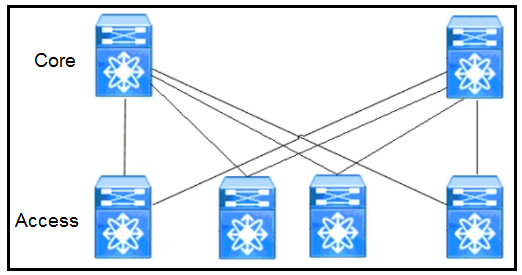
Refer to the exhibit. An engineer must migrate the current topology to a topology that provides more speed, less latency, and support for software-define networks. The new topology has these requirements:
• separation into core, aggregation, and access routers
• varied server-to-server latency, depending on the path used
• support for extending the Layer 3 domain by combining access and aggregation routers
Which design topology meets these requirements?
Key Takeaways
It tests distinguishing three-tier traits—three separate layers and non-uniform per-path latency—from spine-leaf's two-layer, equal-cost, predictable design.
This 300-610 question asks which data center topology separates core, aggregation, and access routers and has path-dependent server latency. The answer is the three-tier design (B), not spine-and-leaf.
Common mistake: Choosing spine-and-leaf (C) because the migration goal mentions speed, low latency, and SDN, even though the enumerated constraints explicitly require three separate layers and varied per-path latency.
Expert Analysis
What the bullets actually describe The decisive clue is the first bullet: separate core, aggregation, and access routers. That is the three-tier data center model, not a two-stage spine-and-leaf fabric. A spine-leaf design collapses access and aggregation into the leaf layer and uses the spine as the core, so it cannot satisfy a literal three-layer separation. Flood-and-learn is a forwarding/learning behavior, not an architecture, and core-edge is a two-layer collapsed model.
Path through the topology Trace a server-to-server flow: server → access switch → aggregation router → core router → aggregation router → access switch → server. If both servers are on the same access switch, the flow may stay local; if not, it crosses the aggregation and possibly the core. STP blocks redundant links, and uplinks are oversubscribed, so available bandwidth and hop count differ by path. That is exactly why latency varies from one server pair to another. In spine-and-leaf every leaf has equal-cost links to every spine, so ECMP gives a predictable number of hops and much less path-dependent latency. The question's "varied latency" bullet therefore points to the three-tier option.
Layer 3 extension The third bullet fits the same model: a three-tier design places the Layer 3 boundary at the aggregation layer, and the design can extend that domain by combining access and aggregation functions. It is not a spine-leaf-only capability. Comments on this question show the trap: one reader selects the three-tier option because "separation should be done into Core Aggregation and Access"; another acknowledges spine-and-leaf's better latency but still chooses it; another calls spine-and-leaf a logical core/access simplification. The explicit requirements decide it: B. three-tier is correct. The migration goal mentions speed, latency, and SDN, but the bullets are the scored constraints and map to three-tier.
Official Reference
This link opens the official vendor documentation in a new tab.
Exam Strategy
When a data center question lists topology traits, map each bullet to a layer count and latency model before reading options. Three distinct core/aggregation/access tiers and non-uniform server-to-server latency belong to three-tier; a two-stage spine/leaf with equal-cost paths belongs to spine-and-leaf. Separate the stated migration objective from the topology being described, and let explicit constraints override the "faster and SDN" keywords.
Frequently Asked Questions
Why isn't spine-and-leaf (C) correct if the goal is lower latency and SDN support?
What causes varied server-to-server latency in a three-tier design?
What does combining access and aggregation routers mean in this three-tier scenario?
Community Votes
50% of anonymous learners picked answer B. Votes are pick records left by other test-takers — they are not the verified answer.
Discussion 3 contributions
Compiled from public community threads and reader submissions, lightly edited for clarity. Handles and vote tallies are shown as recorded, and comments reflect the views of individual contributors.
From public community threads 3
-
chad0128 👍 1 Answered CThe spine-leaf architecture is a simplified, two-layer data center network topology designed to address the limitations of the traditional three-tier architecture. The three-tier architecture uses distinct layers for access, aggregation, and core, while spine-leaf replaces these layers with a spine layer (core) and a leaf layer (access/aggregation). Spine-leaf offers improved performance, scalability, and redundancy for east-west traffic, which is traffic between servers within the data center.
-
lurker8000 👍 1I'll go with C here, although it has a "logical" separation of Core and access and has better low-latency performance than that of a 3tier
-
garza_javi 👍 1 Answered BB since it says that separation should be done into Core Aggregation and Access.
Reader comments & corrections
No reader corrections yet — spotted an error or have a note? Share it below.