Set ip=ibft to expose VIC iSCSI config to RHEL 8
Short answer
D Set the ip=ibft RHEL 8 kernel boot parameter so the installer reads the iBFT initiator and target values programmed on the VIC 1225T iSCSI vNIC
Question
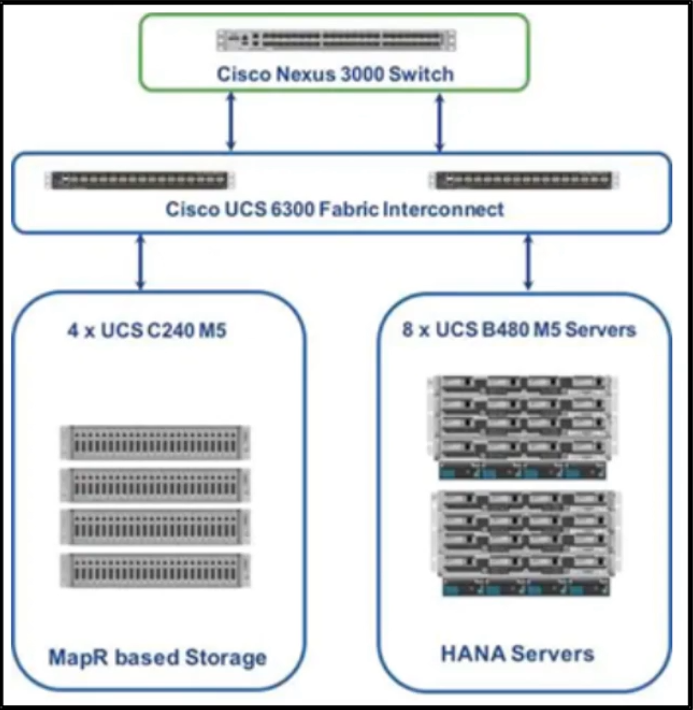
Refer to the exhibit. A Cisco engineer is configuring a Cisco UCS integrated infrastructure for SAP HANA that consists of 8 x Cisco UCS B/C480-M5 servers for SAP HANA and 4 x Cisco UCS C240-M5 C-Series rack mount servers for storage. The rack servers are equipped with Cisco VIC 1225T. The engineer plans to install RHEL8, but the boot process is interrupted at installation because the iSCSI LUNs are not recognized by the VIC adapter. After proper investigation, the engineer concludes that the initiator and target configuration that is programmed on the primary iSCSI VNIC to the operating system is missing. What is the reason for the issue?
Key Takeaways
It tests whether you know that a VIC-programmed iSCSI initiator and target reach the OS only through the iSCSI Boot Firmware Table, which requires the ip=ibft kernel parameter at install time.
This 300-610 question covers iSCSI boot with Cisco VIC adapters on UCS integrated infrastructure for SAP HANA. The correct answer is D: the ip=ibft boot parameter must be set so RHEL 8 reads the iSCSI configuration from the adapter firmware.
Common mistake: Option A is the tempting pick because missing LUNs look like a storage reachability fault, but the values are already programmed on the vNIC — the OS simply never imports them.
Expert Analysis
What the exhibit scenario actually tests The 8 x Cisco UCS B/C480-M5 SAP HANA nodes and 4 x Cisco UCS C240-M5 storage servers use Cisco VIC 1225T adapters, where the iSCSI initiator and target values (initiator IQN, target IP and IQN, boot LUN, and the associated network settings) are programmed on the primary iSCSI vNIC inside Cisco UCS Manager. That programming lives in the adapter firmware, not in the guest operating system. The firmware exposes it to the host through the iSCSI Boot Firmware Table (iBFT), a well-defined ACPI/DMI structure that Linux reads at boot time.
Why option D is correct
During RHEL 8 installation the installer must be told to look for that table, which is done with the kernel boot parameter ip=ibft. Without it, Anaconda never reads the iBFT, so the pre-configured initiator and target configuration never reaches the OS, the LUNs stay invisible, and installation stops — exactly the reported symptom. The engineer's own conclusion that the initiator and target configuration programmed on the primary iSCSI vNIC is missing to the operating system is the fingerprint of an unread iBFT, not of a broken path.
Why the other options fail Option A (storage unreachable) and option B (network interfaces not configured) would present as a timeout or no-route-to-target failure, but here the values exist on the vNIC and are simply not imported, so connectivity troubleshooting does not fit. Option C is irrelevant: RHEL's Cisco approval status has no bearing on LUN discovery, and C-series/UCS integrated infrastructure supports validated Linux distributions without gating iSCSI boot.
The adjacent decision and what would flip the answer If the iSCSI vNIC itself had no initiator/target values programmed in UCS Manager, or the storage array path were down, the correct action would shift to re-checking the vNIC policy or the target reachability rather than a boot parameter. Operationally, missing this one parameter means every node in the 8-node SAP HANA cluster fails installation identically, forcing a full restart of each provisioning cycle instead of a single quick boot-line correction.
Exam Strategy
When a question says firmware or adapter-level configuration is present but invisible to the operating system, look for a boot-time or driver-load mechanism in the options rather than connectivity fixes. Reject 'unreachable' or 'not configured' answers when the stem confirms the values exist on the vNIC. Kernel boot parameters such as ip=ibft are the standard mechanism for passing storage boot data from adapter firmware to Linux installers.
Frequently Asked Questions
Why does RHEL 8 not detect iSCSI LUNs programmed on a Cisco VIC 1225T?
What does the ip=ibft boot parameter do during installation?
Would a storage or network fault produce this same symptom?
Community Votes
67% of anonymous learners picked answer D. Votes are pick records left by other test-takers — they are not the verified answer.
Discussion 3 contributions
Compiled from public community threads and reader submissions, lightly edited for clarity. Handles and vote tallies are shown as recorded, and comments reflect the views of individual contributors.
From public community threads 3
-
Ayman_B 👍 1 Answered DThe problem is that the Red Hat system does not see the iSCSI settings in the card's firmware. To solve this problem, a parameter must be passed during the installation startup so that the system searches for the iBFT table. Without setting the parameter ip=ibft in the RHEL8 boot options, the operating system will not be able to import the pre-configured iSCSI settings in Cisco UCS Manager, and therefore will not see the disk designated for system installation. I go to D
-
garza_javi 👍 1 Answered DThe Cisco VIC 1225T supports iSCSI boot using iSCSI Boot Firmware Table (iBFT). The iBFT contains the initiator and target configuration programmed into the iSCSI vNIC, including: - iSCSI initiator information. - Target IP address and IQN. - Network interface configuration. - Boot LUN information. During RHEL 8 installation, the operating system must recognize and use this firmware-provided configuration.
-
chad0128 👍 1 Answered AThe missing iSCSI initiator and target configuration on the primary iSCSI VNIC to the operating system indicates a problem with how the server is configured to communicate with the iSCSI storage target. This could involve incorrect initiator IDs, target addresses, or misconfigurations in the iSCSI initiator software on the server.
Reader comments & corrections
No reader corrections yet — spotted an error or have a note? Share it below.