Maximizing RFID Tag Tracking Channels on 802.11b/g APs
Short answer
C Enable tracking optimization on up to four channels within the 2.4-GHz band to maximize monitoring and location calculation of RFID tags.
Question
Key Takeaways
While standard Wi-Fi deployment relies on three non-overlapping channels (1, 6, 11), the specific requirement for RFID tag location calculation allows scanning on up to four channels to optimize performance.
To maximize optimization for monitoring and tracking RFID tags on 802.11b/g access points, Cisco documentation specifies enabling tracking optimization on up to four channels within the 2.4-GHz band.
Common mistake: Most candidates select 3 because they apply general Wi-Fi channel planning rules (non-overlapping channels) rather than the specific feature capability for RFID tracking optimization.
Expert Analysis
Why the Answer Is Correct
According to Cisco's configuration guides for wireless controllers, specifically regarding location services and RFID tracking, you can enable tracking optimization on up to four channels within the 2.4-GHz band of an 802.11b/g access point radio. This feature allows the controller to scan only the channels on which tags are usually programmed to operate, thereby optimizing the monitoring and location calculation process.Why the Other Options Are Wrong
Option B (3) is a common distractor based on the standard number of non-overlapping channels in the 2.4 GHz band (1, 6, 11). While valid for minimizing interference in data networks, it does not represent the maximum optimization limit for the specific RFID tracking feature. Option A (1) and D (11) are incorrect as they either provide insufficient coverage or excessive interference respectively, failing to leverage the optimized scanning capability.Community Comment Notes
Several users pointed out that while 3 is the standard for non-overlapping Wi-Fi, the specific exam objective relates to the technical limit of the tracking optimization feature. As one commenter noted, "To optimize the monitoring and location calculation of RFID tags, you can enable tracking optimization on up to four channels." Another user confirmed this by citing the official Cisco documentation link provided in the comments.Official Reference
https://www.cisco.com/c/en/us/td/docs/wireless/controller/7-4/configuration/guides/scg/scg_wlan.html
This link opens the official vendor documentation in a new tab.
Exam Strategy
When dealing with location services or RFID tracking questions, always look for specific limits defined in the vendor's documentation for that feature, rather than applying general RF planning principles like non-overlapping channels.
Frequently Asked Questions
Why not use 3 non-overlapping channels for RFID?
Does this apply to 5GHz bands too?
Community Votes
50% of anonymous learners picked answer B. Votes are pick records left by other test-takers — they are not the verified answer.
Discussion 6 contributions
Compiled from public community threads and reader submissions, lightly edited for clarity. Handles and vote tallies are shown as recorded, and comments reflect the views of individual contributors.
From public community threads 6
-
robi1020 👍 1 Answered B802.11 b/g wireless networks operate in the 2.4 GHz frequency band and typically use channels 1 through 11 in North America. Each channel in the 2.4 GHz band has a width of 20 MHz. To maximize the optimization of monitoring and tracking RFID tags, it's best to use multiple channels to avoid interference and congestion. The channels should be selected such that they are non-overlapping to minimize interference among neighboring channels. Channels 1, 6, and 11 are considered non-overlapping channels in the 2.4 GHz band. Therefore, to maximize optimization and minimize interference, the optimal choice is: B. 3 channels
-
claudio392 👍 1 Answered CTo optimize the monitoring and location calculation of RFID tags, you can enable tracking optimization on up to four channels within the 2.4-GHz band of an 802.11b/g access point radio. This feature allows you to scan only the channels on which tags are usually programmed to operate (such as channels 1, 6, and 11). https://www.cisco.com/c/en/us/td/docs/wireless/controller/7-4/configuration/guides/consolidated/b_cg74_CONSOLIDATED/m_optimizing_rfid_tracking_on_access_points.pdf
-
rrahim 👍 1 Answered B802.11 b/g operates in the 2.4 GHz band, which has 11 channels in total. However, only 3 non-overlapping channels (1, 6, and 11) are available in this band due to channel overlap issues. Using these 3 non-overlapping channels ensures maximum coverage and minimizes interference, which is critical for effectively monitoring and tracking RFID tags. Using fewer than 3 channels would reduce coverage, while using more than 3 would cause interference and degrade performance.
-
Ocsicccnp 👍 1 Answered CTo optimize the monitoring and location calculation of RFID tags, you can enable tracking optimization on up to four channels within the 2.4-GHz band of an 802.11b/g access point radio. This feature allows you to scan only the channels on which tags are usually programmed to operate (such as channels 1, 6, and 11).
-
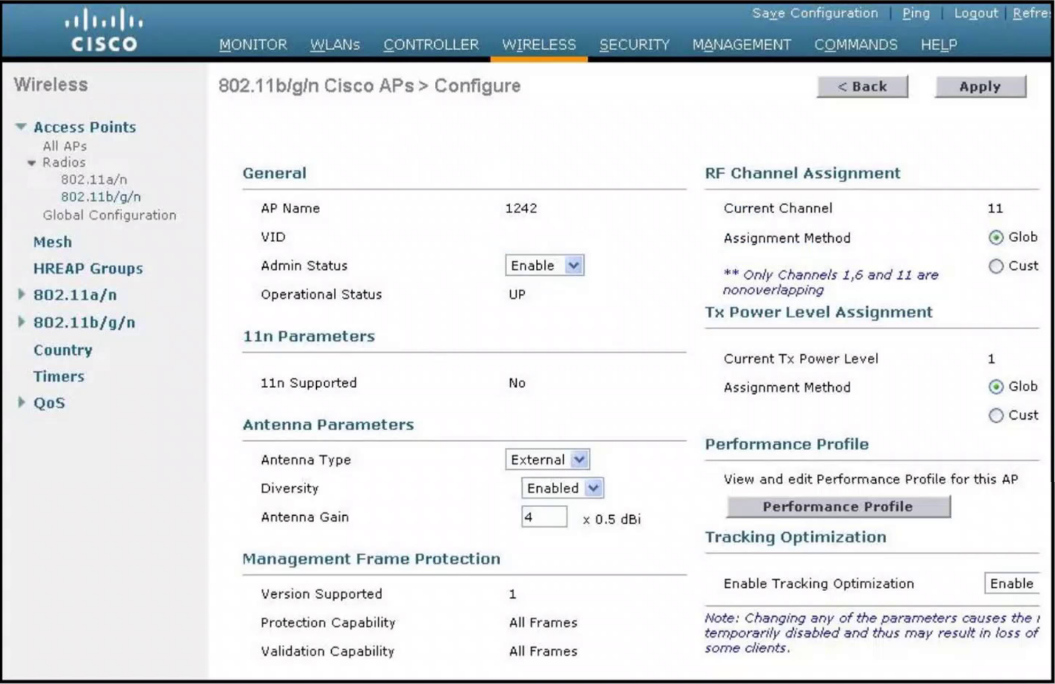
obifunk 👍 1 Answered BB. Would it not be 3 for 802.11b . The image shows channel 11 configured which is for a 3 channel non-overlapping config.
Show 1 more comment
-
Le91 👍 1 Answered CAnswer is C
Reader comments & corrections
No reader corrections yet — spotted an error or have a note? Share it below.