300-410 EIGRP OSPF Redistribution and PBR Simulation

Troubleshoot redistribution between any routing protocols or routing sources Troubleshoot EIGRP (classic and named mode VRF and global) Configure and verify policy-based routing
Answer On R3, remove any 'deny' statements from ACLs 10 and 11 used in route-maps SP1 and SP2. Configure EIGRP metric K-values (100000 1 255 10 1500). Adjust AD on R3 using 'distance eigrp 90 110' or similar to ensure the preferred path is selected, and redistribute OSPF into EIGRP with the specified metric.

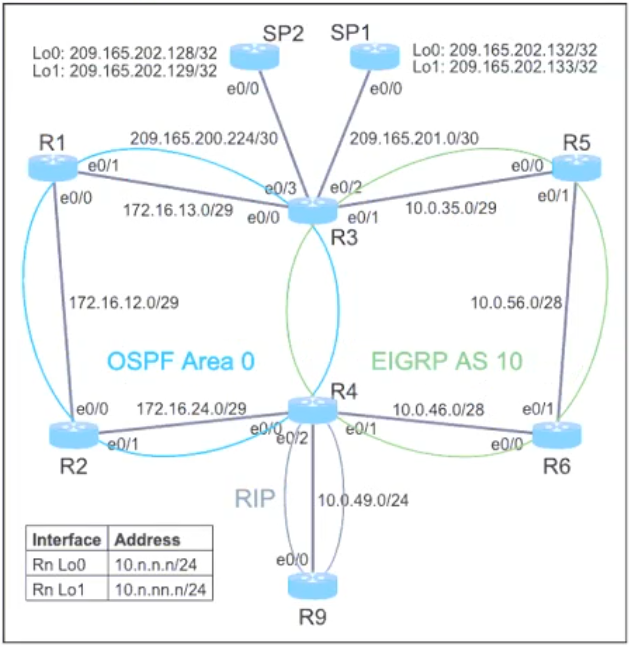
SIMULATION exhibit Guidelines This is a lab item in which tasks will be performed on virtual devices. • Refer to the Tasks tab to view the tasks for this lab item. • Refer to the Topology tab to access the device console(s) and perform the tasks. • Console access is available for all required devices by clicking the device icon or using the tab(s) above the console window. • All necessary preconfigurations have been applied. • Do not change the enable password or hostname for any device. • Save your configurations to NVRAM before moving to the next item. • Click Next at the bottom of the screen to submit this lab and move to the next question. • When Next is clicked, the lab closes and cannot be reopened. Topology exhibit Tasks Troubleshoot and resolve the issues to achieve these goals: 1. Ensure that R1 reaches the prefix 10.6.66.6 without any single point of failure in the path. Do not use a static route or policy-based routing to accomplish this. 2. Ensure that R1 loopback 1 reaches to R6’s loopback 1 by following the path through R1, R3, R5 to R6 and vice versa. Use metric values K1 = 100000, K2=1, K3=255, K4=10, K5=1500 to modify the default metric in EIGRP if required. Do not use a route-map. 3. Ensure that on R3, prefix 10.0.56.6/32 uses the SP1 to route to the Internet, whereas prefix 172.16.12.2/32 uses the SP2 to route to the Internet. Do not use BGP to accomplish this. Use the pre-configured route-maps SP1 and SP2 and modify to accomplish the task if required. Use the ping and trace commands from R6 and R2 to prefixes 209.165.202.132 and 209.165.202.128, respectively to verify the results.
Community Insight

The core challenge is resolving routing conflicts caused by mutual redistribution and incorrect Administrative Distance settings, while fixing broken ACLs in pre-configured route-maps to direct specific prefixes to different Service Providers.

This CCNP Enterprise simulation tests troubleshooting of EIGRP/OSPF redistribution, administrative distance manipulation, and Policy-Based Routing (PBR) using pre-configured route-maps. The solution requires adjusting metrics and removing conflicting static configurations to ensure specific traffic flows.

Candidates often fail to check for existing 'deny' statements in the provided ACLs within the route-maps, which block the required traffic before it can be matched. Additionally, many forget that R4's mutual redistribution creates a routing loop or suboptimal path unless Administrative Distance is manually adjusted on R3.

Community Discussion (34 comments)

SHONA1 👍 1
I had this Sim on my exam on the 18th Sept. It was exactly the same. There was a newer one. Had 4 Sims, 3 from here. 35 questions in total. No drag and drop. Most of the multiple choice from here. The exam started off with them 4 sims.
Curva 👍 1
R1 router eigrp 10 maximum-paths 2 ! All eigrp roteurs router eigrp 10 metric weights 0 100000 1 255 10 1500 R4 interface e0/1 delay 10000 ! artificially increase delay ! R3 ip access-list standard MATCH_SP1 permit 10.0.56.6 ip access-list standard MATCH_SP2 permit 172.16.12.2 route-map SP1 permit 10 match ip address MATCH_SP1 set ip next-hop 209.165.201.2 route-map SP2 permit 10 match ip address MATCH_SP2 set ip next-hop 209.165.200.2 interface e0/1 ip policy route-map SP1 interface e0/0 ip policy route-map SP2
CiscoTerminator 👍 1
will this not be a better route-map for task 3 for PBR on e0/0 and e0/1 since traffic can move either direction due to link failure in network. I want to know your thots on this: route-map ISPSector, permit, sequence 10 Match clauses: ip address (access-lists): 10 Set clauses: ip next-hop 209.165.201.2 Policy routing matches: 0 packets, 0 bytes route-map ISPSector, permit, sequence 20 Match clauses: ip address (access-lists): 11 Set clauses: ip next-hop 209.165.200.226 Policy routing matches: 0 packets, 0 bytes route-map ISPSector, permit, sequence 30 Match clauses: Set clauses: Policy routing matches: 0 packets, 0 bytes
Asta2001 👍 1
Exactly! ip access-list standard PREFIX_SP1 permit 10.0.56.6 ! ip access-list standard PREFIX_SP2 permit 172.16.12.2 route-map SP1 permit 10 match ip address PREFIX_SP1 set ip next-hop 209.165.201.2 209.165.201.1 ! route-map SP2 permit 10 match ip address PREFIX_SP2 set ip next-hop 209.165.200.224
CiscoTerminator 👍 1
does anyone have the full lab question without answer implemented? really want to lab it up
mardemet 👍 1
can someone share the config for task 1 and 2. thank you
Sthib 👍 3
Correct me if I am wrong, the submitted answer is almost correct. The answer is missing the ACLs needed in place on the route map. These ACLs tell traffic from 10.0.56.6/32 and 172.16.12.2 to use the correct service providers. Without the ACLs in place all ingress traffic will go out to either SP1 or SP2. Check running configuration for preconfigured commands such as ACLs or distance. Remove them and set proper configurations.
junya_kimura 👍 3
I had this question on exam. same topology but different question. I am so confused. 1. verify that R2 can reach the prefix 10.5.55.5 without a single point of failure in the path. Do not use static routes or route maps for this 2. follow the path in the order of R1, R5, R6, or vice versa, and verify that R1 loopback 0 reaches R6 loopback 0. If necessary, change the default EIGRP metric using metric values K1 = 100000, K2 = 1, K3 = 255, K4 = 10, and K5 = 1500. Do not use route maps. 3. in R3, ensure that the prefix 10.0.0.0/8 routes to the Internet using SP1 and the prefix 172.16.0.0/12 routes to the Internet using SP2. Do not use BGP for this. Use the preconfigured route maps SP1 and SP2 and modify them to perform the task as needed; use ping and trace commands from R5 and R1 to verify results.
bk989 👍 1
did this config get you a loop when pinging from R1 to R6 loopback, I cant re-create the loop
jabal93 👍 1
any thoughts on how we accomplish task-3 this without BGP ?
jabal93 👍 1
according to the question you can't use BGP so i used PBR on R3 interfaces after i redistributed BGP on both OSPF and EIGRP. Please share your thoughts on the below, R3(config-router)#do sh run | sec ospf| eigrp router eigrp 10 network 0.0.0.0 redistribute ospf 1 metric 100000 1 255 10 1500 redistribute bgp 5500 metric 100000 1 255 10 1500 distance 120 10.0.35.5 0.0.0.0 eigrp router-id 33.33.33.33 router ospf 1 router-id 3.3.3.3 priority 10 redistribute eigrp 10 subnets redistribute bgp 5500 subnets network 192.168.0.0 0.0.255.255 area 0 network 0.0.0.0 255.255.255.255 area 0 ================ R3(config)#int e0/1 R3(config-if)#ip policy route-map SP1 R3(config-if)#int e0/0 R3(config-if)#ip policy route-map SP2
RK139 👍 1
after configuring the task 3 as per your configuration, if i ping from R6 to R1...packets will go to internet.it wont go to R1. but in routing table in R6 route will show from R6-R5-R3-R1. Am i correct?
jabal93 👍 2
I replicate the SIM with the exact subnets, this is task 1-2 R3#sh run | sec rou no ip source-route router eigrp 10 network 0.0.0.0 redistribute ospf 1 metric 100000 1 255 10 1500 distance 120 10.0.35.5 0.0.0.0 eigrp router-id 33.33.33.33 router ospf 1 router-id 3.3.3.3 priority 10 redistribute eigrp 10 subnets network 192.168.0.0 0.0.255.255 area 0 network 0.0.0.0 255.255.255.255 area 0 ================= R4#sh run | sec rou router eigrp 10 network 0.0.0.0 redistribute ospf 1 metric 100000 1 255 10 1500 eigrp router-id 44.44.44.44 router ospf 1 router-id 4.4.4.4 redistribute eigrp 10 subnets network 0.0.0.0 255.255.255.255 area 0 R4#
jabal93 👍 1
Sorry guys, changing the distance will not affect the External routes, we need to change the metrics for EIGRP like the task advice this is the configuration below, i just added one ZERO on the bandwidth for R3. R3-HQ(config-router)#do sh run | sec eig router eigrp 10 network 0.0.0.0 redistribute ospf 1 metric 1000000 1 255 10 1500 R4#sh run | sec eig router eigrp 10 network 0.0.0.0 redistribute ospf 1 metric 100000 1 255 10 1500 R3-HQ(config-router)#do sh run | sec eig router eigrp 10 network 0.0.0.0 redistribute ospf 1 metric 1000000 1 255 10 1500
jabal93 👍 2
Its best practice to put specific source ip address when you are changing the default distance, hence # distance 120 10.0.35.5 0.0.0.0 10.0.35.5 === R5 ip address on eth0/0
jabal93 👍 3
Task-3 R3#sh run | sec acc|route-m route-map SP-1 permit 10 match ip address 10 set ip next-hop 209.165.201.2 route-map SP-1 permit 20 route-map IPS-2 permit 10 match ip address 11 set ip next-hop 209.165.200.226 route-map IPS-2 permit 20 access-list 10 permit 10.0.56.6 access-list 11 permit 172.16.12.2 R3#
bf10690 👍 5
I have had a few variants of this lab on my tests. They have changed some metrics but overall the test is more or less the same. But please be aware that the access lists referenced by SP1 and SP2 sometimes (always?) contain block statements. So you have to recreate those with the correct permit statements. One time I needed to change the AD of RIP on R4 as well, instead of changing the metric.
bk989 👍 2
Note in my lab I didn't have to modify the eigrp redistribution metric, I set it to redistribute ospf 1 metric 1 1 1 1 1. You can do it how the exam asks for, I recommend it. Sometimes we modify the redistribution metric to pool traffic to one side of the network.
bk989 👍 1
here is my config for R4 if you want to practice: router eigrp 1 network 10.0.46.4 0.0.0.0 network 10.4.4.0 0.0.0.255 network 10.4.44.0 0.0.0.255 redistribute ospf 1 metric 1 1 1 1 1 redistribute rip metric 1000000 1 255 10 1500 distance 125 0.0.0.0 255.255.255.255 66 eigrp router-id 4.4.4.4 ! router ospf 1 router-id 4.4.4.4 redistribute eigrp 1 subnets network 10.4.4.0 0.0.0.255 area 0 network 10.4.44.0 0.0.0.255 area 0 network 172.16.24.4 0.0.0.0 area 0 ! router rip version 2 redistribute ospf 1 metric 4 redistribute eigrp 1 metric 4 network 10.0.0.0 no auto-summary
bk989 👍 2
here is my config if you want to practice: R3: router eigrp 1 network 10.0.35.3 0.0.0.0 network 10.3.3.0 0.0.0.255 network 10.3.33.0 0.0.0.255 redistribute bgp 1 metric 1 1 1 1 1 eigrp router-id 3.3.3.3 ! router ospf 1 router-id 3.3.3.3 redistribute eigrp 1 subnets redistribute bgp 1 subnets network 10.3.3.0 0.0.0.255 area 0 network 10.3.33.0 0.0.0.255 area 0 network 172.16.13.3 0.0.0.0 area 0 default-information originate ! router bgp 1 bgp log-neighbor-changes redistribute eigrp 1 redistribute ospf 1 neighbor 209.165.200.226 remote-as 2 neighbor 209.165.201.1 remote-as 2 (the bgp is for the SP neighbors)
bk989 👍 2
Now R1 has the route advertised from R3. And the traceroute: R1#trace 10.6.66.6 Type escape sequence to abort. Tracing the route to 10.6.66.6 VRF info: (vrf in name/id, vrf out name/id) 1 172.16.13.3 20 msec 6 msec 5 msec 2 10.0.35.5 1 msec 6 msec 6 msec 3 10.0.56.6 6 msec 5 msec 5 msec
bk989 👍 3
The above traceroute goes through R4 which is longer path. The question asks for R1 -->R3 --> R5 --> R6. When we issue this command on R3: R3(config)# R3(config-router)#no distance 125 0.0.0.0 255.255.255.255 66 Now R3 has 10.6.66.6 as a better route in eigrp compared to OSPF E2 route of R4, and redistributes it into OSPF 1 and installs it into LSDB. Now R3 has better route: R3#show ip ro *Jul 16 22:22:07.702: %SYS-5-CONFIG_I: Configured from console by console R3#show ip route <.......> D 10.5.5.0/24 [90/409600] via 10.0.35.5, 00:02:15, Ethernet0/1 D 10.5.55.0/24 [90/409600] via 10.0.35.5, 00:02:15, Ethernet0/1 D 10.6.6.0/24 [90/51379200] via 10.0.35.5, 00:02:15, Ethernet0/1 D 10.6.66.0/24 [90/51379200] via 10.0.35.5, 00:02:15, Ethernet0/1 And now R3 installs this into its OSPF LSDB and advertises it to R1.
bk989 👍 1
The same is true for R1 as now R1 has best path through R4, as R3 never advertises the 10.6.66.6 route into OSPF from EIGRP distance 125, as it already has a route to 10.6.66.6 distance 110. R1#trace 10.6.66.6 source L0 Type escape sequence to abort. Tracing the route to 10.6.66.6 VRF info: (vrf in name/id, vrf out name/id) 1 172.16.12.2 6 msec 1 msec 5 msec 2 172.16.24.4 6 msec 5 msec 5 msec 3 10.0.46.6 6 msec 5 msec 5 msec
bk989 👍 4
I figured it out. R4 mutually redistributes EIGRP and OSPF into eachother before R3 does redistribution. After R3 does redistribution R3 has 2 paths to 10.6.66.6 network. R3 chooses EIGRP as it has lower administrative distance. However in the simlet we use distance command to make EIGRP distance higher, than external OSPF distance of 110. In my lab this is what it looks like, for EIGRP 1 and OSPF 1 process (I did not use process number of 10): router eigrp 1 network 10.0.35.3 0.0.0.0 network 10.3.3.0 0.0.0.255 network 10.3.33.0 0.0.0.255 redistribute bgp 1 metric 1 1 1 1 1 distance 125 0.0.0.0 255.255.255.255 66
bk989 👍 2
R4 mutually redistributes before R3 does: router eigrp 1 network 10.0.46.4 0.0.0.0 network 10.4.4.0 0.0.0.255 network 10.4.44.0 0.0.0.255 redistribute ospf 1 metric 1 1 1 1 1 redistribute rip metric 1000000 1 255 10 1500 distance 125 0.0.0.0 255.255.255.255 66 eigrp router-id 4.4.4.4 Now because R3 has distance 125 command to 10.6.66.6, we see R3 chooses the path to R4, on the other side of the network. R3#show ip route <...........> D 10.5.5.0/24 [90/409600] via 10.0.35.5, 00:22:17, Ethernet0/1 D 10.5.55.0/24 [90/409600] via 10.0.35.5, 00:22:17, Ethernet0/1 O E2 10.6.6.0/24 [110/20] via 172.16.13.1, 00:05:05, Ethernet0/0 O E2 10.6.66.0/24 [110/20] via 172.16.13.1, 00:05:05, Ethernet0/0 Notice that for the 10.5.55.0/24 loopback of R5, R3 still chooses EIGRP 1 as it has lower AD, but since 10.6.66.0/24 has distance of 125 for EIGRP, R3 chooses the path to R4
bk989 👍 1
I cannot get the loop to work properly, as it did on the exam. When I pinged 10.66.6.6 from R1 source Loopback0/1 it goes to R6 without a loop. I am mutually redistributing on both R3 and R4, but this causes suboptimal routing, and not a routing loop ~ any suggestions?
jabal93 👍 1
check my config
Ivan_AGC 👍 5
I got this SIM in my Exam, please pay attention to the ACL in my test the ACLs were already created and matched in the route map. The ACLs have a Deny for the networks 172.0.0.0 and 10.0.0.0. So you need to delete it before starting the configuration.
jabal93 👍 2
Thank you
chaba7654321 👍 4
Had this lab on the exam, pretty much the same - and the provided answer in config is pretty accurate. I had a different metric set under eigrp distance for 0.0.0.0 255.255.255.255, but removing it fixed the issue so not too important Used traceroute to troubleshoot flow as suggested
cloud29 👍 2
Is that provided answer is correct?
LooserDragon 👍 2
Be aware, because they can have different metrics on the routers on the real sim. Ensure that R6 takes the route through R5 instead of R4 (because the PBR won’t work that way). If it does, you can configure the link between R6 and R4 with lower bandwith OR the link between R6 and R5 with higher.
jabal93 👍 1
That's what has been bothering me, how we supposed to tunnel the traffic for R6 through R5 in order to hit our applied PBR on R3, after we done forcing the traffic inside EIGRP domain to exit through R4... thanks bruh adjusting the bandwidth has passed my mind. hhh
Bombbear_W 👍 7
So glad to see this simulation is finally added. Well done examtopics team and appreciated it.

Comments & Corrections

No comments yet — spotted an error or have a note? Share it below.

Log in to comment, report an error, or add a note about this question.

Submitted for moderation before publishing. Keep it helpful and respectful.

Expert Analysis

Why the Answer Is Correct

The simulation requires three distinct actions: first, ensuring redundancy for 10.6.66.6 by manipulating Administrative Distance (AD) so R3 prefers the EIGRP path over the OSPF external path learned via R4; second, configuring EIGRP metrics (K-values) to force the specific path through R5; and third, fixing the PBR on R3 by editing the SP1 and SP2 route-maps. The community confirms that the pre-configured ACLs often contain 'deny' entries for the target networks, which must be removed or corrected to permit the traffic.

Why Other Candidate Answers Are Wrong

Incorrect approaches typically involve adding static routes, which violates the explicit constraint "Do not use a static route." Another common error is ignoring the AD conflict between EIGRP (AD 90) and OSPF External (AD 110); if R4 redistributes OSPF into EIGRP and vice versa, R3 might prefer the longer path via R4 unless the AD for the external prefix is raised above 110 or the internal EIGRP AD is lowered. Failing to fix the ACLs results in all traffic being dropped by the route-map rather than being forwarded to the correct ISP.

Community Comment Notes

Users highlight that the ACLs are a major trap: "the ACLs were already created and matched in the route map... have a Deny for the networks... So you need to delete it". Others note the importance of AD adjustment: "we use distance command to make EIGRP distance higher..." to prevent R3 from choosing the suboptimal path through R4. One user confirmed the exact configuration needed: "route-map SP-1 permit 10 match ip address 10 set ip next-hop 209.165.201.2".

Exam Strategy

Always inspect the running configuration for pre-existing objects like ACLs and Route-Maps before starting. If a task seems impossible with standard routing protocols, check for hidden 'deny' rules in ACLs or incorrect Administrative Distance settings that override your intended path selection.

Frequently Asked Questions

Why do I need to change the Administrative Distance on R3?

R4 mutually redistributes EIGRP and OSPF, creating multiple paths. Changing the AD ensures R3 prefers the direct EIGRP path over the OSPF external path via R4.

What is wrong with the pre-configured ACLs in this lab?

The pre-configured ACLs often contain 'deny' statements for the target networks (e.g., 10.0.0.0), blocking traffic. You must remove these denies or modify them to 'permit' the specific prefixes.

More 300-410 FAQ →

Related Analysis

Practice All 300-410 Questions

Access 159 questions with complete answers and detailed explanations.

View Full 300-410 Practice Test →

← Back to 300-410 Study Guide
