DHCP Snooping Option 82 Blocking DHCP Addresses on SW3?
Short answer
B Disable DHCP Option 82 insertion on SW3 with `no ip dhcp snooping information option` so DHCP requests are not dropped.
Question
 -
- 
Key Takeaways
Tests DHCP snooping Option 82 handling across multiple switches; the trap is assuming a missing
ip helper-address(D) rather than the snooping option mismatch.
HostA and HostB fail to get DHCP addresses because SW3 drops requests carrying Option 82 inserted by an upstream snooping switch. The fix is to disable Option 82 insertion on SW3 with no ip dhcp snooping information option (B).
Common mistake: Choosing `ip helper-address 1.0.0.2` (D), but the DHCP server is reachable via relay already and the failure is caused by DHCP snooping rejecting Option 82, not a missing relay.
Expert Analysis
Why the Answer Is Correct
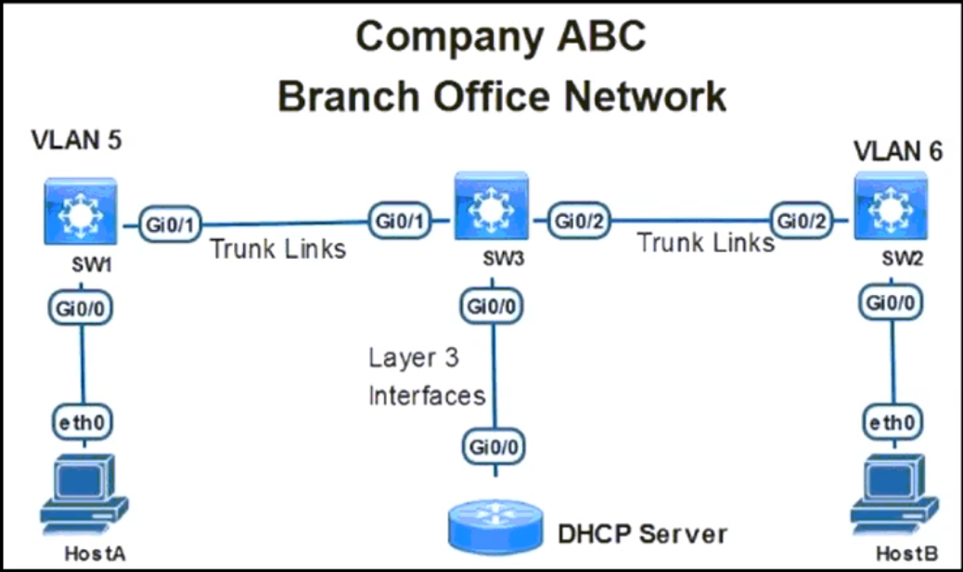
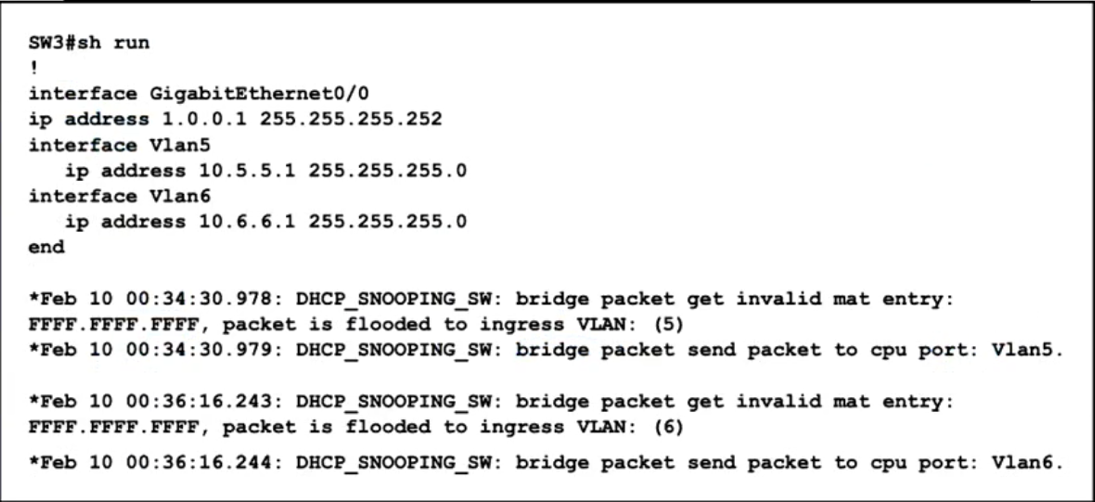
The exhibit shows HostA and HostB failing to obtain IP addresses even though DHCP snooping is enabled. In a multi-switch topology, an intermediate switch running DHCP snooping inserts Option 82 into DHCP requests received on untrusted ports. When those requests reach another snooping switch or a DHCP server that does not expect Option 82, the packets can be dropped. On SW3, which sits between the hosts and the DHCP server, the no ip dhcp snooping information option command stops SW3 from adding Option 82, allowing the DHCP requests to be forwarded normally. This matches Cisco's recommended fix for situations where clients behind a second snooping switch cannot get addresses, as referenced in the community thread.
Why the Other Options Are Wrong
ip dhcp relay information option-insert (A) is a relay-agent command that enables Option 82 insertion, not a fix for unwanted insertion. ip dhcp server use subscriber-id client-id (C) is a DHCP server command that changes the client identifier used for lease lookup; it has no effect on snooping behavior on SW3. ip helper-address 1.0.0.2 (D) configures a relay address for a Layer 3 interface, but the failure is not a missing relay—DHCP requests are already being relayed (or SW3 is not the Layer 3 gateway). As Anarky19 pointed out, the DHCP server sits in a different subnet and no invalid-option log was observed, which suggests the issue is the snooping Option 82 handling rather than the helper address.
Community Comment Notes
Anarky19 questioned why D is not correct, noting the server is in a different VLAN and no invalid DHCP options log appeared, but the majority still favored B. Brahim90 confirmed B and highlighted that IPv6 DHCP relay uses a different command (ipv6 dhcp relay destination), which is irrelevant here. dapardo linked a Cisco community discussion about DHCP snooping clients not getting IP addresses, which supports disabling Option 82 insertion. leipeG explained that no ip dhcp snooping information option disables Option 82 insertion, which is sometimes necessary for older DHCP servers or clients. Gesti simply agreed with B.
Official Reference
https://community.cisco.com/t5/switching/dhcp-snooping-clients-not-getting-ip-address/td-p/1749969
This link opens the official vendor documentation in a new tab.
Exam Strategy
When DHCP snooping is enabled on multiple switches, remember that Option 82 can cause silent drops. Check for no ip dhcp snooping information option on intermediate switches before troubleshooting Layer 3 relay configurations.
Frequently Asked Questions
Why is `ip helper-address 1.0.0.2` (D) not the correct answer?
What does `no ip dhcp snooping information option` do?
Community Votes
67% of anonymous learners picked answer B. Votes are pick records left by other test-takers — they are not the verified answer.
Discussion 5 contributions
Compiled from public community threads and reader submissions, lightly edited for clarity. Handles and vote tallies are shown as recorded, and comments reflect the views of individual contributors.
From public community threads 5
-
Anarky19 👍 4 Answered DWhy not D? The dhcp server is in a different subnet/vlan 1.0.0.0/30 than hosts (vlan 5 for host A 10.5.5.0/24 and vlan 6 for host B 10.6.6.0/24) I can't see in the log messages something like: DHCP_SNOOPING: invalid DHCP options - unable to parse In conclusion, why do you think B is the best answer?
-
Brahim90 👍 3 Answered BCorrect answer is B. The reason why D is incorrect because the ip helper address for ipv6 is different from ipv4. R1# config t Enter configuration commands, one per line. End with CNTL/Z. R1(config)# interface gigabitethernet0/0 R1(config-if)# ipv6 dhcp relay destination 2001:db8:a:b::7
-
dapardo 👍 3 Answered BIm going with B considering this information: https://community.cisco.com/t5/switching/dhcp-snooping-clients-not-getting-ip-address/td-p/1749969
-
leipeG 👍 2The "no ip dhcp snooping information option command" disables the insertion of DHCP Option 82. This might be necessary in certain environments where devices (like older DHCP servers or clients) do not support or need Option 82 information.
-
Gesti 👍 1It's B
Reader comments & corrections
No reader corrections yet — spotted an error or have a note? Share it below.
Related Analysis
Practice All 300-410 Questions
Access 159 questions with complete answers and detailed explanations.
View Full 300-410 Practice Test →