Which R1 next hop has the least desirable metric?
Short answer
C 10.10.10.3's OSPF route 110/100 carries the highest (least desirable) metric value on R1.
Question
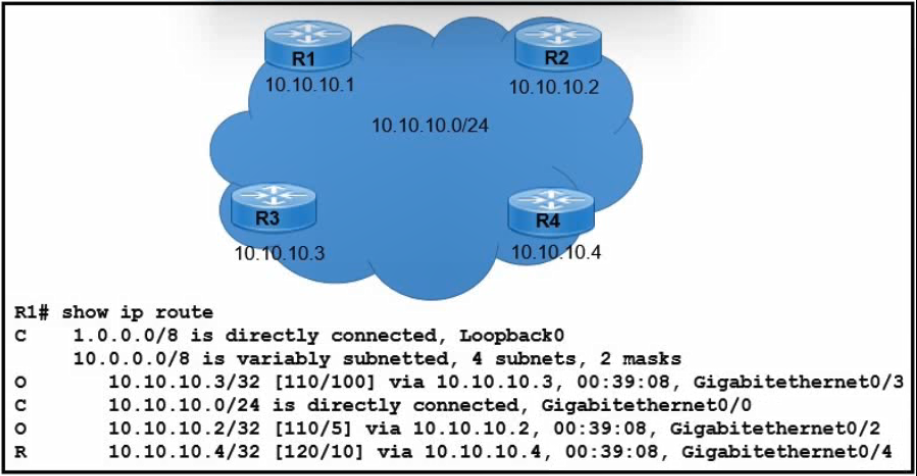
Refer to the exhibit. Which next-hop IP address has the least desirable metric when sourced from R1?
Key Takeaways
The question tests reading the AD/metric pair and isolating the metric: the trap is treating administrative distance (110, 120) as the metric, or dismissing the RIP entry without computing its hop-count metric of 10.
This 200-301 routing-table question asks which next hop from R1 shows the least desirable metric. Comparing the OSPF costs of 100 and 1 against the RIP hop count of 10, next hop 10.10.10.3 (metric 100) is the least desirable, so the answer is C.
Common mistake: Choosing A (10.10.10.4, the RIP route 120/10) because RIP's higher administrative distance looks 'worst' — but the question asks about the metric, and RIP's metric of 10 hops is lower than OSPF's cost of 100 on 10.10.10.3.
Expert Analysis
Reading the exhibit's routing entries
From R1's routing table the relevant next hops are: 10.10.10.2 reachable via OSPF with 110/100 (metric 100), 10.10.10.3 via OSPF with 110/1 (metric 1), and 10.10.10.4 via RIP with 120/10 (metric 10 hops). 10.10.10.5 is never shown as a next hop, so option B is not even a candidate — a point many participants make when rejecting it.
"Least desirable metric" means the largest metric
The question asks specifically about the metric, not about which route is preferred. Among the entries that carry a genuine metric value, the numbers are 100, 1 and 10. The largest of these is 100, which belongs to next hop 10.10.10.2, so option C is the answer. The trap here is the common confusion between administrative distance and metric: 110, 120 and 100 are AD values, and it is only the second number in AD/metric that is the metric. Several participants conflate the two, and others argue "metrics of different protocols can't be compared" — true in a pure preference sense, but the question is asking which value is worst, not which route wins.
Why not the RIP route (option A)
RIP's 120/10 looks bad because AD 120 is the least preferred protocol, but its metric is only 10 hops. Judged strictly as a metric it is smaller than OSPF's 100, so A does not satisfy "least desirable metric." OSPF's metric is cumulative cost, and a cost of 100 is the least desirable (highest) metric value among the listed next hops, making C the correct choice.
Eliminating the rest Option B (10.10.10.5) is absent from the routing table, so no metric exists to evaluate; option D (10.10.10.2's neighbour) and option A are out once the RIP metric of 10 is compared against OSPF's 100.
Exam Strategy
On routing-table interpretation items, write down each candidate as AD/metric and compare only the second number when the question says 'metric'; reserve AD comparisons for 'best route' or 'preferred' wording. Also confirm the option's next hop actually appears in the table before scoring it — entries absent from the exhibit have no metric at all and can be discarded immediately.
Frequently Asked Questions
Why isn't the RIP route 120/10 the least desirable metric?
Can metrics from OSPF and RIP really be compared?
Why is 10.10.10.5 not a valid answer?
Community Votes
57% of anonymous learners picked answer C. Votes are pick records left by other test-takers — they are not the verified answer.
Discussion 29 contributions
Compiled from public community threads and reader submissions, lightly edited for clarity. Handles and vote tallies are shown as recorded, and comments reflect the views of individual contributors.
From public community threads 29
-
oatmealturkey 👍 23 Answered C10.10.10.5 is not even in the topology diagram or shown as a next hop in the routing table at all so how can it be B???
-
Rynurr 👍 12 Answered CYeah "C". the least desirable metric = highest metric in OSPF
-
Dutch012 👍 7 Answered DIts D, D's metric is 5 which is the least desirable
-
dropspablo 👍 3 Answered A(I choose the letter A because RIP hops metric is less desirable than OSPF cost metric.) "When a single routing protocol learns multiple routes to the same subnet, the metric tells it which route is best. However, when two different routing protocols learn routes to the same subnet, because each routing protocol’s metric is based on different information, IOS cannot compare the metrics. For example, OSPF might learn a route to subnet 10.1.1.0 with metric 101, and EIGRP might learn a route to 10.1.1.0 with metric 2,195,416, but the EIGRP-learned route might be the better route—or it might not. There is simply no basis for comparison between the two metrics. When IOS must choose between routes learned using different routing protocols, IOS uses a concept called administrative distance. (OCG v1 Chapter 19: Understanding OSPF Concepts)"
-
PaddyInNZ 👍 3A typically poor question. There are three routing types to choose from: Directly Connected, RIP, and OSPF. These are differentiated by the AD value (not metric). Each of these types have their own metric value, however one cannot simply compare them. It would be like comparing apples with oranges. One is a measure of cumulative cost (OSPF), whilst the other is a measure of hops (RIP). However, for a purely numerical value, the worst (highest) metric is 100 (10.10.10.3/32). As such, option ‘c’ is the least wrong answer. A truly asinine question.
Show 24 more comments
-
Peter_panda 👍 3Could be A. It does not say anywhere that we are referring only to OSPF learned routes, but only with OSPF routes we can compare metrics. The RIP route is the least desirable overall (higher AD), but its metric cannot be compared with anything (there are no other RIP routes).
-
Gene_nstudy 👍 3 Answered AA silly question. Routing is basically based on the destination IP address. It is nonsense to think about when sourced from R1.Does Cisco properly review the exam questions?
-
Rydaz 👍 3why not A? because its RIP AD of 120 so it's the highest, wich means least desirable. ?
-
maheshmgr 👍 3least desirable means not desirable or undesirable = highest metric :
-
hamish88 👍 3You made my day. :)) The lower the number, the better
-
blue91235 👍 3For the ospf only , or in general ?
-
lucantonelli93 👍 3 Answered CIt's C the answer , please correct
-
Stichy007 👍 3 Answered Clols this is hilarious, ans is c
-
gewe 👍 3option C has highest metric.
-
NASIR0CITV 👍 2 Answered BWhen R1 encounters an unknown next-hop IP address that is not defined in its routing table, it will typically assign a high metric to that route. This is because the router has no information about the path through the unknown next-hop and cannot accurately determine its quality or performance. As a result, the unknown next-hop will have the least desirable metric when sourced from R1 compared to the next-hops that are defined in the routing table.
-
rogi2023 👍 2I agree, very stupid "cisco" kind question. I red the question again and again to find the solution key. The RIP route 120/10 is for sure the worst with 10hops..but I just play dum and assume they wanna know the highest # after "/" so I would go with answer "C". I hope not to see this quiestion with these wording on exam.
-
Njavwa 👍 2 Answered C[110/100] = 100 = AD, 100 = metric the more we think about it the more it doesn't make much sense. least should be the one with the highest Metric... all we wanted was to much a normal revision with less debate its so unfortunate that ITEXAMS completes things
-
Friday_Night 👍 2it's a lot better if these so called "experts" don't put an answer at all. let the community decide the best answer. I'm assuming the questions are from cisco but the answers are not
-
Carlolo 👍 2no wonder people resort to dumpings
-
a67c04a 👍 2 Answered CC - least desirable metric is 100
-
lferolm 👍 2 Answered AAD is higher than the others
-
Njavwa 👍 2110 = AD 100 = metric
-
Ineng 👍 1 Answered ARIP AD is higher compare to OSPF. Higher the Ad the least desirable. You will just consider metric if longest prefix and ad are the same.
-
maximus_007 👍 1 Answered CC is correct. Know the differences between AD and metric values for your distance vector and dynamic protocols.
-
EXD 👍 1the key word here is metric! C is with the highest metric among all. the AD is not in question here.
-
RPG_1984 👍 1should we look only for metric? is it useful to compare metric values shown in different protocols?
-
1Abel1 👍 1 Answered CThink of it as worse metric number (least desirable)
-
eb63e5a 👍 1if not C its other concept
-
Net_eng_pogi 👍 1trolling
Reader comments & corrections
No reader corrections yet — spotted an error or have a note? Share it below.
Related Analysis
Practice All 200-301 Questions
Access 220 questions with complete answers and detailed explanations.
View Full 200-301 Practice Test →