DHCP Relay with ip helper-address for VLAN 10
Short answer
C Configure ip helper-address 192.168.20.2 on the SW1 VLAN 10 interface so DHCP requests from VLAN 10 clients are relayed to the remote DHCP server.
Question
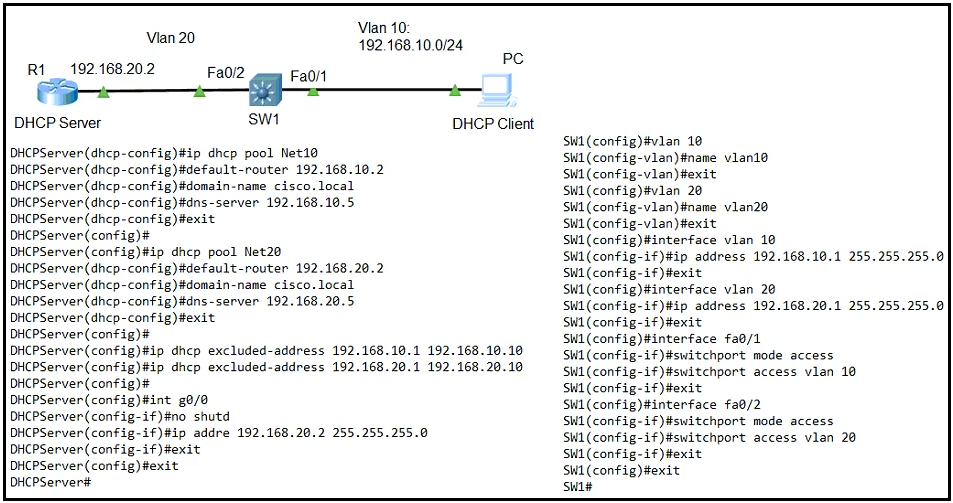
Refer to the exhibit. The DHCP server is configured with a DHCP pool for each of the subnets represented. Which command must be configured on switch SW1 to allow DHCP clients on VLAN 10 to receive dynamic IP addresses from the DHCP server?
Key Takeaways
The question tests DHCP relay: ip helper-address must reference the DHCP server itself, and the common trap is confusing the server's address (192.168.20.2) with the subnet's default gateway (192.168.20.1) or with the local VLAN 10 SVI (192.168.10.x).
DHCP clients on VLAN 10 sit in a different broadcast domain from the DHCP server, so SW1 must act as a relay agent and forward BOOTP/DHCP requests with the ip helper-address command configured on the VLAN 10 SVI. The correct helper address is the DHCP server's own interface address, 192.168.20.2, not the VLAN 20 gateway address.
Common mistake: Option D (ip helper-address 192.168.10.2) is the most frequent wrong pick, especially from learners reasoning that "VLAN 10 clients need a VLAN 10 address." 192.168.10.2 is inside the clients' own subnet, so there is nothing to relay — a local server on the same subnet is reached by broadcast without a helper address at all.
Expert Analysis
Why the Answer Is Correct
Clients in VLAN 10 send DHCP Discover as a limited broadcast, which routers do not forward, so SW1 must relay the request to a DHCP server on another network. The ip helper-address parameter is the unicast address of the DHCP server itself — and on this topology the server reachable in the 192.168.20.0/24 network is 192.168.20.2. The command is applied on the interface (the VLAN 10 SVI, SW1's gateway for that VLAN) facing the clients, and the relayed Discover lets the server issue a lease from its Net10 pool while the offer returns with a 192.168.10.x address to the client. This matches option C.
Why the Other Options Are Wrong
192.168.20.1 (B) is the gateway/first usable address of the server subnet, not the DHCP server's address, so relayed requests would be sent to a device that cannot answer DHCP. 192.168.10.1 (A) is a local VLAN 10 address — a helper address that points back into the clients' own broadcast domain is pointless and provides no relay function. 192.168.10.2 (D) is in the clients' own subnet; as oatmealturkey noted, "if we only needed 192.168.10.2 for DHCP for VLAN 10, then we would not need an IP helper address," because a same-subnet server is discovered by broadcast directly.
Community Comment Notes
Most commenters converged on C, with Rynurr and Da_Costa both pointing to "192.168.20.2" as the server interface used as the helper address. oatmealturkey captured the core concept by warning learners that they are "thinking of the default gateway" instead of the DHCP server, and matass_md revised an initial wrong reading of the exhibit, concluding "our SW is the DG to our PC, we put there the IP helper then it sends it to another network." The dissenting votes for D (from Muziaws and sdmejia01) rest on the intuition that VLAN 10 clients need a VLAN 10 address, which confuses the leased address with the relay target.
Exam Strategy
On any DHCP relay question, first separate the three addresses in play: the clients' gateway (VLAN 10 SVI), the server's own address, and the server subnet's gateway. ip helper-address always takes the server's address, configured on the client-facing interface; if a server existed in the same subnet as the clients, no helper address would be required at all.
Frequently Asked Questions
Why can't the ip helper-address be 192.168.10.2 for VLAN 10 clients?
Why is 192.168.20.1 wrong instead of 192.168.20.2?
Discussion 15 contributions
Compiled from public community threads and reader submissions, lightly edited for clarity. Handles and vote tallies are shown as recorded, and comments reflect the views of individual contributors.
From public community threads 15
-
oatmealturkey 👍 13It is C. You are thinking of the default gateway, we need the DHCP server address which is 192.168.20.2. The exhibit with the long output is meant to throw us off, just look at the topology diagram and it is there. If we only needed 192.168.10.2 for DHCP for VLAN 10, then we would not need an IP helper address.
-
Rynurr 👍 13 Answered CWhy "D"? The correct answer is "C". ip helper-address 192.168.20.2
-
matass_md 👍 3So IP helper-address command must be on the Default-Gateway of our respective VLAN. So in this scenario our host is in VLAN 10 has a pool Created named Net10, we have two DHCP servers created for VLAN 10 and VLAN 20 Net 20 (READ THE commands inserted on R1 not the 192.168.20.2 IP address that you see on the picture , that's a trap ). We can't tell PC 1 get your IP address from DHCP Server on VLAN 20 because then you will have no internet connectivity because the our port F0/1 is in VLAN 10! We need our PC to get a valid IP address from 192.168.10.2 Then it will have connectivity on Port FastEthernet 0/1 access port vlan 10. Right answer D, 192.168.10.2 THIS is where we want our broadcast Discovery message to go as a UNICAST , to this address, because we have a DHCP server for each VLAN !!!
-
Friday_Night 👍 3yeah it's C and if cisco wants us to be more confused they would show same commands in different SVIs :))
-
Muziaws 👍 3The question is asking about clients on VLAN 10 so how can C be correct
Show 10 more comments
-
matass_md 👍 2Ignore my above message, the right answer is 192.168.20.2 . our SW is the DG to our PC , we put there the IP helper then it sends it to another network (that is normal) and we receive an Offer with 192.168.10.x IP back . Final answer C .
-
Tamunodiepiriye 👍 2 Answered CC is correct because the ip helper-address command will be for an address on another subnet
-
Da_Costa 👍 2 Answered CLooking at the server address which is used as helper address 192.168.20.2
-
sdmejia01 👍 2 Answered DD is correct!
-
ebachka 👍 1Ok this going to be long. Correct me if I am wrong please. 1st we have a multilayer switch with interswitch vlan routing going on. Ip helper should be applied on the routing interface closest to the clients, because the discover messages cant pass layer 3 interface without ip helper. On the switch we have Interface VLAN 10 192.168.10.1. So any device trying to exit the broadcast domain from vlan 10 has to go thru this interface. So that's where we should apply the IP Helper command on. Then we look for the IP Address of the DHCP Server and it looks like the IP Address of the server is Int g0/0 192.168.20.2. So the correct answer should be SW1(config)int vlan 10 , SW1(config-if)ip helper-address 192.168.20.2
-
Lse 👍 1 Answered CWhen configuring the ip helper-address command on the switch, you should use the IP address of the router's interface that is directly connected to the subnet where the client devices reside, not the default router IP.: The ip helper-address command tells the switch (or router) where to forward DHCP requests.
-
eb63e5a 👍 1D can't be answer, because 192.168.10.2 address is not given for any interface, it is just configured on router. We don't know on which interface it is given, since we have only one connected interface, which is even access port. But 192.168.20.2 is given for router interface. This is why I pick C
-
7fa6509 👍 1 Answered CThe correct answer is C. Given that the DHCP server interface IP address is 192.168.20.2, there is no DHCP server with the IP address 192.168.10.2. Consider this: if you choose option D, where would the DHCP relay agent obtain assistance?
-
HelloPeople 👍 1DHCP Network command not configured
-
ds0321 👍 1 Answered Dvlan 10 , must be D
Reader comments & corrections
No reader corrections yet — spotted an error or have a note? Share it below.
Related Analysis
Practice All 200-301 Questions
Access 220 questions with complete answers and detailed explanations.
View Full 200-301 Practice Test →