Connected Route vs Local /32 Host Route in show ip route
Short answer
C The destination is on the connected 10.10.10.0/24 network of GigabitEthernet0/0/0, whose subnet mask is 255.255.255.0, not the /32 local host route.
Question
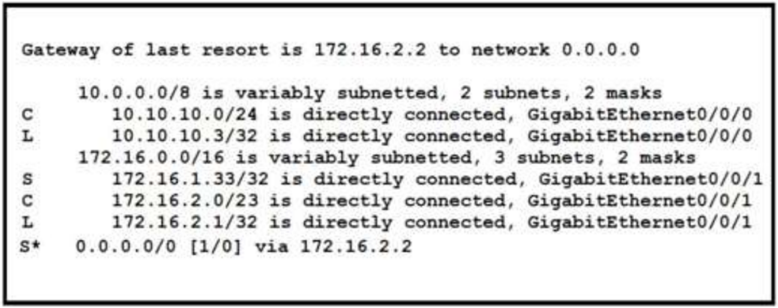
Refer to the exhibit. A packet that is sourced from 172.16.3.254 is destined for the IP address of GigabitEthernet0/0/0. What is the subnet mask of the destination route?
Key Takeaways
The trap is confusing the L /32 local host route for the interface address with the C /24 connected network route; the question asks for the mask of the destination's network route, which is 255.255.255.0.
This 200-301 routing question tests the difference between a connected route and a local host route in show ip route. The correct answer is C: the destination network on GigabitEthernet0/0/0 uses subnet mask 255.255.255.0 (the /24 connected entry), while the /32 local entry is only the interface's own host address.
Common mistake: Choosing D (255.255.255.255) because the L 10.10.10.3/32 local route matches the interface IP exactly — but that /32 entry is a host route for the router's own address, not the subnet mask of the destination network route. Option B (255.255.254.0) is wrong because it comes from the source address's 172.16.2.0/23 subnet, which is irrelevant to the destination.
Expert Analysis
The destination in this question
The packet is destined for the IP address configured on GigabitEthernet0/0/0. In the exhibit's show ip route output, two entries touch that interface: C 10.10.10.0/24 (the connected network) and L 10.10.10.3/32 (the local host route for the interface address itself). The question asks for the subnet mask of the destination route, and the correct choice is C, 255.255.255.0, because that is the mask of the connected network route that actually carries the destination's subnet.
Connected vs. local: the boundary being tested
A connected (C) route represents the network prefix assigned to the interface — here 10.10.10.0/24, mask 255.255.255.0. A local (L) route, introduced so IOS 15 output no longer needs show ip int br, represents only the one interface address and always uses /32 (255.255.255.255). Commenters who pick D quote the local-route definition, but they are answering a different question: the /32 entry is a host route for the interface address, not the subnet mask of the destination's network route. Others note the L entry exists "since IOS 15" precisely to show interface IPs, reinforcing that it is not a subnet.
Why the source address and option B are traps
The source 172.16.3.254 sits in 172.16.2.0/23, which lured one comment toward B, but the source address plays no role in selecting the destination's mask — the question asks about the route to the interface IP, not the source subnet. Option A, 0.0.0.0, is the default route mask and appears only as * default entries, irrelevant here. So the destination route mask is C, 255.255.255.0.
Exam Strategy
On routing-table questions, first identify which entry answers the exact noun in the stem — "destination route" means the network prefix (C, connected), while the interface's own address maps to the L /32 local entry. Ignore distractor data such as the source IP unless the question explicitly asks about the source subnet or the forwarding path; masks like 0.0.0.0 and 255.255.254.0 are classic red herrings pulled from other lines or other subnets.
Frequently Asked Questions
What is the difference between a connected (C) and local (L) route?
Why does show ip route list both 10.10.10.0/24 and 10.10.10.3/32?
Does the source address 172.16.3.254 affect the destination route mask?
Community Votes
63% of anonymous learners picked answer D. Votes are pick records left by other test-takers — they are not the verified answer.
Discussion 31 contributions
Compiled from public community threads and reader submissions, lightly edited for clarity. Handles and vote tallies are shown as recorded, and comments reflect the views of individual contributors.
From public community threads 30 of 31
-
paolino555 👍 12 Answered D"for the IP address of GigabitEthernet0/0/0"
-
j1mlawton 👍 9 Answered DIf we're looking for the destination subnet mask then I go for D 255.255.255.255
-
mageknight 👍 6C 10.10.10.0/24 refer to the subnet which is connected to L (local) 10.10.10.3/32. the /32 refer exclusively/exactly to this host and this host is the destination mapped with g0/0/0 interface, so the mask is 255.255.255.255. Sorry for my english...
-
ike110 👍 5 Answered DThe key phrase here is "destined for the IP address of GigabitEthernet0/0/0", which is the ip of the interface and this host. - /32
-
TommyCisco 👍 5 Answered DDestined for the IP address of GigabitEthernet0/0/0 and the IP address of G0/0/0 is 10.10.10.3/32
Show 25 more comments
-
JJY888 👍 4 Answered DThis help me clear this up: A connected route represents the network address. It uses the actual subnet prefix (mask). A local route represents the host address. It always uses the subnet prefix /32.Dec 20, 2021 Connected Routes and Local Routes Explained ComputerNetworkingNotes https://www.computernetworkingnotes.com › connected-. Connected = Network Address Local = Address of the interface So the questing is what is the interface subnet mask?
-
jackie2010 👍 4I choose Answer B. Because the IP range of the routing path for 172.16.2.0/23 is 172.16.2.0 to 172.16.3.255 The packet destination IP 172.16.3.254 is the last available IP within this range. If the CIDR notation is /23, the subnet mask should be 255.255.254.0
-
593554d 👍 4 Answered Ddestined for the IP address of GigabitEthernet0/0/0 Ip address of the router /32 local route
-
SVN05 👍 4Can someone help to further explain why the answer is C or D for that matter. Thank you.
-
rogi2023 👍 3 Answered CIt's a bit tricky question. Asume this scenario: You wanna remotely ssh/telnet to that router interface IP. On that router the cmd "sh ip route" shows what in the exhibit, not saying anything how was the netw 10.10.10.0/24 advertised. Starting with IOS 15 (i guess) the output shows also the local intf IP's as JJY888 explained. I disagree with ike110, because any valid unicast host IP is a /32 address. So therefore they are asking for the /24 subnet from the RT. and the key phrase is "what is the subnet mask of the destination route" Of course I might be wrong, if the /32 route for the intf was advertised .. So for me the C - correct answer.
-
Shaifalimittal02 👍 3 Answered CThe packet is sourced from 172.16.3.254. It is destined for the IP address of GigabitEthernet0/0/0, which corresponds to the network 10.10.10.0/24, as seen in the routing table: C 10.10.10.0/24 is directly connected, GigabitEthernet0/0/0. L 10.10.10.3/32 is directly connected, GigabitEthernet0/0/0 (the specific IP on that interface). This indicates that GigabitEthernet0/0/0 is part of the 10.10.10.0/24 network. Therefore, the subnet mask of the destination route is: C. 255.255.255.0, which corresponds to a /24 network.
-
Olebogeng_G 👍 3When you look at the routing table, code C stands for connected network, the network that the interface is connected to. Code L refers to the IP address of the interface that the network is connected to. If the IP address of the interface connected to network 10.10.10.0 is 10.10.10.3, then the subnet of that interface must be /32. So D.
-
picho707 👍 3 Answered DThis test has become a grammar test instead of a technical one. The interface gi0/0/0 is directly connected and the subnet mask is /32 so the subnet must be 255.255.255.255.
-
zamkljo 👍 3Agree but it would've been better if they made it clear that looking got "Host Route" or "Network Route". That "destination route" still is confusing.
-
Scarfa 👍 3The answer is C. Mask /32 is for the local address of the router. The destination subnet mask is /24.
-
rasadebayor 👍 2 Answered DIt is D because "Note that the router also automatically produces a different kind of route, called a local route. The local routes define a route for the one specific IP address configured on the router interface. Each local route has a /32 prefix length, defining a host route, which defines a route just for that one IP address. For example, the last local route, for 172.16.5.1/32, defines a route that matches only the IP address of 172.16.5.1. Routers use these local routes that list their own local IP addresses to more efficiently forward packets sent to the router itself." (CCNA official Cert, p. 378)
-
ZeroK 👍 2 Answered CC. 255.255.255.0 Here's why the other options are incorrect: A. 0.0.0.0: This is the default subnet mask for Class A networks, but it's not applicable here. The routing table shows specific subnet masks for each route. B. 255.255.254.0: This subnet mask could be used on a network, but it doesn't match the subnet mask in the routing table for the destination route. D. 255.255.255.255: This is a /32 subnet mask, which creates a single-host network. It's unlikely to be used for a GigabitEthernet interface connecting to another network.
-
PHIL95240 👍 2C is the good answer because the question specifies : What is the subnet mask of the destination? Local is for the local equipment, Connected is for the subnet. The good line to use in the Route Table is where you see 10.10.10.0/24. The mask is 255.255.255.0
-
PHIL95240 👍 2You're certainly right because it wrote "is destined for the lP address of GigabitEthernet0f0f0" so the only mask for one host is /32 so the answer D (255.255.255.255) should be good.
-
shiv3003 👍 2 Answered Dmask of the destination ip adr
-
SVN05 👍 2Thank you so much.
-
hands 👍 2 Answered Ctricky question
-
dropspablo 👍 1 Answered CClosed mask /32 is not the "connected" subnet (just a "local" host), in this case the interface g0/0/0 has the following configuration: (config-if)# ip add 10.10.10.3 255.255.255.0. Do not get confused, because in the "#show ip route" output, the "Local" ip address (L) will always be shown with a closed mask (255.255.255.255), but the "Connected" network (C) will show the subnet. If asked which host mask would be /32, but the subnet mask is /24.
-
baanyan 👍 1the correct answer is C after ios 15 : we have both Connected(C) route and Local(L) route. Connected route: network address with network subnet mask Local route: the interface address, so we do not need to use "sh ip int br" to check. The subnet mask is always 32 bit, since it is a host address. In this case, we are asked about the destination route subnet mask, we should check the connected(C) route.
-
dropspablo 👍 1We don't know if the destination route points to the subnet or the host, but even if the route pointed directly to the host (/32), that's just the configuration, /32 is not considered a subnet, just a local host. If 10.10.10.3 /32 were a subnet then what would its broadcast address be?
-
matass_md 👍 1 Answered Cso C is for connected meaning the 10.10.10.0/24 is the NETWORK addresss The is LOCAL 10.10.10.3/32 the IP on the interface and /32 it's a HOST ROUTE . The right answer is 255.255.255.0 C this is the subnet mask for the destination network.
-
kynnor 👍 1I think the correct Answer is D. Routing use the LONGEST MATCH PREFIX Algorithm https://networklessons.com/cisco/ccna-200-301/longest-prefix-match-routing in this case /32 is longer than /24
-
eb63e5a 👍 1C is correct because, destination is gigabitEthernet 0/0/0 and this interface is configured as /24 , which is 255.255.255.0
-
PHIL95240 👍 1After reflection the answer should be "D. 255.255.255.255" like I wrote just before for " 593554d "
-
maximus_007 👍 1 Answered D/32 uses a 255.255.255.255 mask so D is correct.
Reader comments & corrections
No reader corrections yet — spotted an error or have a note? Share it below.
Related Analysis
Practice All 200-301 Questions
Access 220 questions with complete answers and detailed explanations.
View Full 200-301 Practice Test →