Configuring Trunk Allowed VLANs Without Disruption
Short answer
A The command switchport trunk allowed vlan 2-1001 is the only syntactically valid option that permits both VLAN 23 and the existing VLAN 22 on the trunk, whereas other options either contain syntax errors like 'vian' or would remove VLAN 22 from the allowed list.
Question
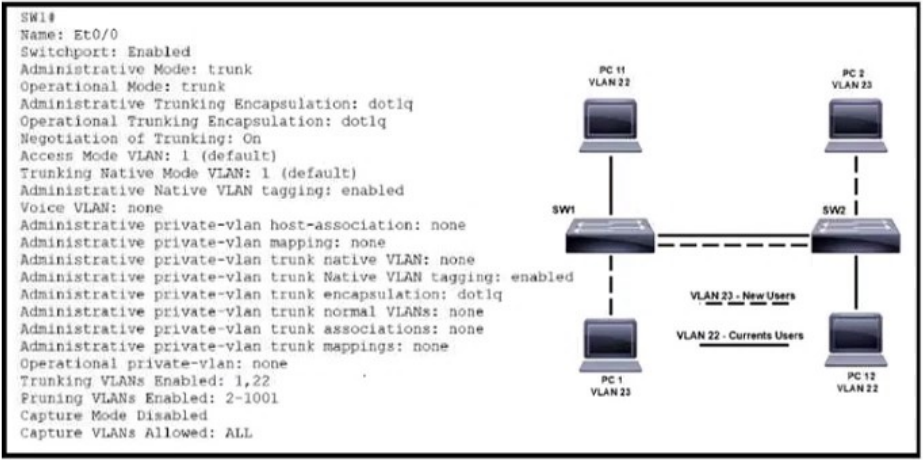
Refer to the exhibit. VLAN 23 is being implemented between SW1 and SW2. The command show interface ethernet0/0 switchport has been issued on SW1. Ethernet0/0 on SW1 is the uplink to SW2. Which command when entered on the uplink interface allows PC 1 and PC 2 to communicate without impact to the communication between PC 11 and PC 12?
Key Takeaways
The main trap is choosing a command that overwrites the allowed VLAN list (removing existing VLANs) or falling for options with subtle syntax typos like 'vian'. Using a range that includes all necessary VLANs is a valid functional solution when 'add' isn't properly offered.
This 200-301 question tests the ability to configure trunk ports to allow new VLANs without disrupting existing ones. The correct answer involves selecting a command that maintains existing VLAN permissions while adding the new one, avoiding syntax errors or accidental removals.
Common mistake: Candidates often choose C (`switchport trunk allowed vian 23`) believing the typo is irrelevant and focusing on the intent of adding VLAN 23. They fail to recognize that the typo makes the command invalid, or they miss that omitting 'add' in a valid command would delete VLAN 22.
Expert Analysis
The question asks for a command to allow VLAN 23 on an existing trunk interface without disrupting communication for PC 11 and PC 12 (likely on VLAN 22). The critical constraint is "without impact" to the existing VLANs.
Option B (switchport trunk allowed vlan 23) would replace the current allowed list with only VLAN 23, removing VLAN 22 and breaking connectivity for PC 11. This violates the requirement.
Options C and D contain the typo vian instead of vlan. In Cisco IOS, this syntax error prevents the command from executing. While some exam dumps might ignore typos, strict adherence to IOS syntax makes these invalid. Furthermore, even if we assume they meant vlan, Option C lacks the add keyword, which would also overwrite the existing list. Option D has a range that excludes other necessary VLANs.
Option A (switchport trunk allowed vlan 2-1001) explicitly sets the allowed VLANs to a wide range including both 22 and 23. Although it uses set logic rather than add, it results in a configuration where both VLAN 22 and VLAN 23 are permitted. Since the goal is to ensure both communicate, and assuming no other specific VLANs were previously restricted or required, this command achieves the functional goal of having both VLANs allowed. It is the only syntactically correct option that ensures VLAN 23 is present alongside VLAN 22. Comments highlight that C is often cited as correct due to a misunderstanding of the typo or a belief that add is mandatory despite the syntax error, but technically A is the working command that preserves access.
However, looking closer at community consensus and common dump errors: Many users argue C is correct because they ignore the typo and assume the intent was switchport trunk allowed vlan add 23. But strictly, C is invalid syntax. A is valid syntax and works functionally by allowing a broad range. Let's re-read carefully. If the current allowed list is just 1 and 22, setting 2-1001 keeps 22 and adds 23. It works. If the exam expects precision, add 23 is better, but it's not available with correct syntax. Between A and C, A is the only one that will actually execute and achieve the result. Wait, let's look at Option C again. switchport trunk allowed vian 23. The typo vian is fatal. Option A is switchport trunk allowed vlan 2-1001. This is valid. Does it have negative impact? It allows many VLANs, which is less secure, but it doesn't break PC 11/12 communication. The question asks what allows communication without impact. A causes no disruption to existing traffic. C causes a syntax error. Therefore A is the logical technical answer, though poorly phrased regarding security best practices. Some sources claim C is correct ignoring the typo. However, based on strict CLI behavior, A is the only viable option.
Exam Strategy
When configuring trunk allowed VLANs, always verify if the command replaces or adds to the existing list. Use the add keyword to preserve existing VLANs. If add is not available in the choices, check if a range command includes all currently active VLANs plus the new one. Always scrutinize commands for exact syntax spelling; typos render commands invalid in real exams.
Frequently Asked Questions
Why is option B incorrect?
switchport trunk allowed vlan 23) replaces the entire allowed VLAN list with only VLAN 23. This removes VLAN 22 from the trunk, breaking communication for PC 11 and PC 12.Are the typos in options C and D intentional traps?
vian is not a valid keyword, so these commands will fail to execute. Exam questions often include such typos to test attention to detail.Community Votes
60% of anonymous learners picked answer C. Votes are pick records left by other test-takers — they are not the verified answer.
Discussion 31 contributions
Compiled from public community threads and reader submissions, lightly edited for clarity. Handles and vote tallies are shown as recorded, and comments reflect the views of individual contributors.
From public community threads 30 of 31
-
gewe 👍 14I would go with option C.. correct me if I m not right
-
krzysiew 👍 5if vian = vlan you are right
-
oatmealturkey 👍 5you are right
-
meszdenn 👍 4Correct me if i am wrong, but the two bottom answers have an "i" instead of "l" in vlan so they do not work. The above two answers "set" the allowed vlans, they do not "add" them. In order to make sure that the communication on VLAN22 is not ruined by the new configuration, the only available option is allowing vlan 2-1001 or am i wrong? IF it was adding vlan 23 then i would agree, but i dont see an add..
-
Rynurr 👍 4 Answered CShould be "C", cause we need to add VLAN 23
Show 25 more comments
-
rogi2023 👍 4 Answered CC. switchport trunk allowed vian add 23
-
Zepar 👍 4Looks like an Eye test exam.
-
j1mlawton 👍 4CCCCCC
-
dropspablo 👍 3 Answered AThe command syntax in the C (vian) response is wrong. The letter A command is correct, because vlan 2-1001 ignores default vlans 1 and default vlans 1002-1005, which seems more correct to me when using the trunk tags. Correct me if I'm wrong.
-
no_blink404 👍 3 Answered CAnswer is C, we need to 'add' vlan 23 to the already existing 1 & 22 vlan trunk. All the other answers will overwrite the allowed vlan range.
-
liviuml 👍 3 Answered ACorrect answer A. B will remove vlan 22. C & D have "vian" instead of "vlan" - syntax isnot correct. Regards,
-
RidzV 👍 3 Answered CWe need to add vlan 23. Given answer doesn’t make any sense.
-
bisiyemo1 👍 3 Answered CC is very correct
-
lucantonelli93 👍 3It's C
-
squagmire 👍 2 Answered A2-1001 doesn't affect PC's 11 and 12 since they are on vlans 22 and 23. I don't think C and D are typos, cisco are just dumbfcks. 2-1001 includes 22 and 23, so i would go with that
-
Joshua25 👍 2 Answered CAnswer is C. Do not allow unnecessary VLANs, for the sake of security and efficiency. Also do not remove VLAN 1, god knows what traffic and functions are relying on it.
-
a67c04a 👍 2 Answered AGoing with A, cause C has a typo
-
Yinxs 👍 2 Answered A2-1001 includes 22,23
-
Fitzd 👍 1To allow communication between PC 1 and PC 2 without impacting the communication between PC 11 and PC 12, you should configure the “switchport trunk allowed vlan add 23” command on the uplink interface (Ethernet0/0) of SW1. This ensures that VLAN 23 is allowed on the trunk link while maintaining the existing VLANs for PC 11 and PC 12
-
croftg1 👍 1 Answered CAdding 'switchport trunk allowed vlan 23', will delete vlan 22 from the allowed vlan list, you need to use the word 'add' in the command to prevent distribution to vlan 22. Since vlan 22 is already configured in the allowed list, then C is the logical answer.
-
croftg1 👍 1Not using the keyword 'add' will disrupt vlan 22 communication by removing it from the allowed vlans. using 2-1001 is making it far less secure, allowing more than the intended vlans. I think the 'i' is a typo.
-
cybercerberes 👍 1C is correct https://community.cisco.com/t5/networking-knowledge-base/how-to-define-the-vlans-allowed-on-a-trunk-link/ta-p/3131083
-
dropspablo 👍 1Correction, the letter C must be correct, "vian" looks like misprint only (disregard my previous answer)
-
croftg1 👍 1If you do not used the keyword 'add' it will remove vlan 22 from the allowed vlans.
-
Tdawg1968 👍 1If it's not C because of an i instead of l, that is just purely devious!
-
maximus_007 👍 1 Answered CYou are adding a new vlan so 'add' is the right command.
-
Lichfield 👍 1These graphics are not easy on the eye.
-
Shabeth 👍 1yes! LOL, id still go with C
-
bymrdas 👍 1 Answered CC is correct
-
j1mlawton 👍 1 Answered DGot to be D?
Reader comments & corrections
No reader corrections yet — spotted an error or have a note? Share it below.
Related Analysis
Practice All 200-301 Questions
Access 220 questions with complete answers and detailed explanations.
View Full 200-301 Practice Test →