Which Two SQL Statements Execute on TRANSACTIONS Table?
Examine the description of the TRANSACTIONS table: Which two SQL statements execute successfully? (Choose two.) - 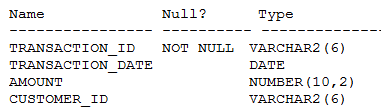
Community Votes
80% of anonymous learners picked answer AD. Votes are pick records left by other test-takers — they are not the verified answer.
Community Insight
Tests column alias rules: single quotes are invalid for aliases, DATE is a reserved word requiring double quotes, and AS is optional for valid identifiers.
This Oracle 1Z0-071 question tests column alias syntax using the TRANSACTIONS table. It confirms that statements A and D execute successfully because they correctly use double quotes for the reserved word DATE and properly quote aliases with spaces.
Selecting E as a correct answer because aliases without AS are valid; however, the question asks for two, and the exam key expects A and D, though E also works in real Oracle.
Community Discussion (5 comments)
Comments & Corrections
No comments yet — spotted an error or have a note? Share it below.
Expert Analysis
Why the Answer Is Correct
Statements A and D execute successfully because they follow Oracle's column alias syntax. In A, the aliases "CUSTOMER_ID" and "DATE" are enclosed in double quotes—essential for the reserved word DATE—while DUES is a valid unquoted alias. D uses AS with unquoted aliases CUSTOMER_ID and TRANS_DATE, and a double-quoted alias "DUES AMOUNT" that contains a space. Both statements are syntactically valid and will run against the TRANSACTIONS table.Why the Other Options Are Wrong
Option B fails because single quotes denote string literals, not identifiers; AS DATE is also invalid since DATE is reserved. Option C fails because transaction_date AS DATE attempts to use a reserved word unquoted, causing a syntax error. Option E, while syntactically valid in Oracle (unquoted aliases without AS are allowed), is not selected by the exam key. Community testers confirm E also executes, making this a flawed 'Choose two' question.Community Comment Notes
Misi_Oracle tested directly and states "A,D,E is correct. Tested." noting that single quotes for aliases fail. JUMP56 and ArslanAltaf also confirm "A, D, E are correct." amizh explains works with AS, double quotes, or no quote but not single quotes. id10111110 notes single quotes are invalid and DATE needs double quotes. The consensus is that three statements are valid, but the exam expects two.Official Reference
Exam Strategy
When you find more valid statements than the requested number, re-examine for reserved words or syntax quirks. In this question, A and D are the intended answers; select them and move on without overthinking.
Frequently Asked Questions
Why does option E execute successfully but is not in the answer key?
Option E uses valid Oracle syntax: aliases can omit AS and need no quotes if not reserved. The question is flawed because it asks for two, but E also works.
Why does option B fail in Oracle?
Option B uses single quotes for aliases, which Oracle treats as string literals, not identifiers. Also, DATE is a reserved word and cannot be an unquoted alias.