Matching Asset, Threat, Risk, and Vulnerability Definitions
Short answer
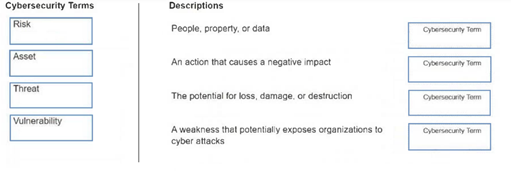
People, property, or data → Asset; an action that causes a negative impact → Threat; the potential for loss, damage, or destruction → Risk; a weakness that potentially exposes organizations to cyber attacks → Vulnerability.
Question
Move each cybersecurity term from the list on the left to the correct description on the right.
Note: You will receive partial credit for each correct answer.
Key Takeaways
It tests whether you separate the protected thing, the weakness, the actor/event, and the probability of loss — with threat-versus-vulnerability being the main trap.
This drag-and-drop tests the four core cybersecurity definitions: asset, threat, risk, and vulnerability. Correctly, people/property/data is an asset, a negative-impact action is a threat, potential for loss is risk, and an exploitable weakness is a vulnerability.
Common mistake: Swapping threat and vulnerability: a threat is an actor or event with intent and capability, while a vulnerability is the weakness in an asset that the threat exploits.
Expert Analysis
The mapping to memorise This drag-and-drop pairs four foundational terms with their textbook definitions: People, property, or data is an Asset; an action that causes a negative impact is a Threat; the potential for loss, damage, or destruction is Risk; and a weakness that potentially exposes organizations to cyber attacks is a Vulnerability. A learner comment restates exactly this four-way mapping, which matches the vendor's essential security principles vocabulary.
Why these four are confused The definitions differ by one crucial word each. An asset is what you protect — tangible (hardware, facilities) or intangible (data, reputation, people). A vulnerability is inherent in the asset or its configuration: an unpatched port, weak password policy, missing encryption. A threat is an actor or event with the capability and intent to exploit that weakness — a ransomware group, a malicious insider, a hurricane. Risk is the likelihood that the threat actually exercises the vulnerability and causes measurable impact. The classic chain is: asset + vulnerability + threat → risk. If the exam swaps two definitions, ask "does this describe the thing being protected, the hole, the actor, or the probability of loss?"
The adjacent decision this covers The neighbouring objective pairs this with risk treatment: mitigate (patch the vulnerability), transfer (insurance), avoid (retire the asset), or accept (when residual risk falls within appetite). Recognising which element you are acting on decides the treatment — you cannot "patch" a threat, and you cannot "insure away" a vulnerability itself.
What changes the answer If a description said a control that reduces likelihood or impact, the correct bucket would be a mitigation/control, not risk. If it named the event already having occurred, it would be an incident, not a threat. Examiners deliberately blur threat (intent + capability) with vulnerability (weakness) — threat intelligence identifies who could attack, vulnerability management identifies what is weak.
Operational consequence Misclassifying these leads teams to remediate the wrong object: buying monitoring for a configuration flaw, or patching an external actor. Incident triage, risk registers and CVSS reporting all start with this vocabulary, so a slip here propagates into every downstream process.
Exam Strategy
Anchor each definition to a single keyword: asset = what you protect, vulnerability = the weakness, threat = the actor/event, risk = probability of loss. When two options look alike (threat vs. vulnerability), ask whether the phrase describes a hole or an intention, then drag the term whose keyword matches. Apply partial credit by fixing the pairs you are certain of first, since each correct match scores independently.
Frequently Asked Questions
How do I tell a threat from a vulnerability in a drag-and-drop question?
Why is risk described as potential loss rather than an actual loss?
What connects asset, vulnerability, threat, and risk?
Discussion 1 contributions
Compiled from public community threads and reader submissions, lightly edited for clarity. Handles and vote tallies are shown as recorded, and comments reflect the views of individual contributors.
From public community threads 1
-
Roattana 👍 1• People, property, or data \(\rightarrow \) Asset • An action that causes a negative impact \(\rightarrow \) Threat • The potential for loss, damage, or destruction \(\rightarrow \) Risk • A weakness that potentially exposes organizations to cyber attacks \(\rightarrow \) Vulnerability
Reader comments & corrections
No reader corrections yet — spotted an error or have a note? Share it below.